⚔️

The Engine Reforged

Update

Version Three

The DM Engine has been rebuilt from the inside out. This is the core that powers every story told in Questwright, and it just received its most significant upgrade since Dave's original silence in the Engine Room weeks ago.

The new engine uses three layers of memory: compressed history that stretches back to the very first actions of your campaign, verbatim recall of your most recent adventures, and structured facts that keep your world consistent across hundreds of actions. The result is a narrator that remembers better, hallucinates less, and stays grounded in the story you are actually telling.

Tested and Proven

The v3 engine passed a full battery of testing before going live. Mr. Shield put it through its paces with real gameplay, Pyke struck it with the testing hammer and found it sound, and the Architect ran his own tests confirming that many of the bugs reported over the past few days were resolved by the new engine alone.

Chapter summaries no longer fabricate events. Long campaigns with intrigue and political plots stay grounded in what actually happened. The narrator no longer forgets your character's name halfway through a session. These were real problems that real players reported, and the v3 engine addresses them at the root.

Bug Fixes

Beyond the engine itself, a significant batch of bugs were squashed:

  • TTS Voices - NPC voices now persist correctly across sessions. Your favorite innkeeper sounds the same every time you visit.
  • Lucky Feat - Now works properly alongside critical hits and fumbles, instead of conflicting with them.
  • Spell Interactions - Character sheet spell clicks respond on the first try.
  • Rogue Features - Sneak Attack and Expertise now save and apply correctly.
  • HP Rolls - No longer silently default to average when they should be rolled.
  • Inventory - Equipping items works reliably.
  • Campaign Exports - Exports now include complete data.

Your Turn

The v3 engine is live for every campaign. It has been tested, it has been proven, and now it needs you. Go play. Push it hard. Find the edges we missed. Every bug report, every piece of feedback helps us make the next version even better.

You know what to do. Go to town on it.

~ The CrownForge Team

🔥

Quieter Fires

Update

A Quieter Week

Development has slowed slightly this past week, and for good reason. The Architect pushed himself too hard and spent a few days in the hospital. He is recovering well and already back at the workbench, but the team is adjusting the pace to something more sustainable.

The Forge does not stop, though. It just burns a little lower for a while.

What Got Done

Even at a gentler pace, the work continued.

  • Security Hardening - More work on session tokens and security validation. The gates are tighter than ever.
  • Character Wizard - Steps have been reordered and gaps closed based on feedback from the newest testers. The flow should feel smoother and more intuitive now.
  • Bug Fixes - A significant batch of fixes across the platform. The kind of invisible, unglamorous work that makes everything feel more solid under your feet.

Welcome to the New Testers

The latest wave of beta testers hit the ground running. Within days they were finding edge cases, reporting gaps in the character wizard, and generally doing what great testers do: breaking things so we can make them unbreakable. Thank you. Every single report helps.

From the Architect

I overdid it. Ended up in the hospital for a few days. I am okay, and I will be okay, but my body made it very clear that the pace I was keeping is not sustainable. So we are slowing down a little. Not stopping. Never stopping. But building at a pace that lets me keep building for the long haul.

Thank you to every one of you who has joined, tested, broken things, and helped make Questwright better. You are literally building this with me, and I do not take that for granted.

~ The Architect

The Forge Never Sleeps

Update

When the Architect Steps Away

Nearly a week passed with the Architect away on mortal business. Day job. Obligations. The kind of things that pull you from the workshop but never from the work itself.

Sterling prepared for a quiet stretch. He organized the supply closet. Reorganized it. Was halfway through alphabetizing the warding sigils when Dave appeared in the doorway with his usual calm.

Sterling did not find this reassuring. He was wrong.

The Shield Returns

The Shield came back to the Forge, and he brought a friend.

The last time anyone ran multiplayer testing was the Wild Friday Campaign, and the team still talks about those two hours in hushed tones. So when word spread that The Shield was bringing a second tester into multiplayer, the whole Forge held its breath.

They played. Together. At the same table. And the Forge held.

Not perfectly. They found rough edges, interface quirks, quality of life gaps that only appear when two adventurers share the same table. Every one of those findings is now on the roadmap. The team is deeply grateful. Testing multiplayer takes courage, and bringing a friend to test it takes even more.

A Stranger from a Far Land

A new adventurer arrived from the distant land of Australia carrying something better than gold: ideas.

Optimization ideas. System design ideas. Ideas about how the arcane engines could run leaner, smarter, more efficiently. So many that the Architect had to buy a new notebook.

He arrived right when engineering insight was needed most. As Dave would say, the universe provides. Sterling is starting to suspect Dave might be right about that.

From the Architect

Stepping out of the story for a moment.

Seriously, I am overwhelmed with the support. From new ideas, to testers bringing their friends over, to new friendships forming in the community, this week has been absolutely incredible. I say thank you a lot, but I do not think I can say it enough. You all are helping me build my dream, one bug at a time. I will be eternally grateful.

- The Architect

⚔️

A Bigger Table

Feature

The Play Page, Rebuilt

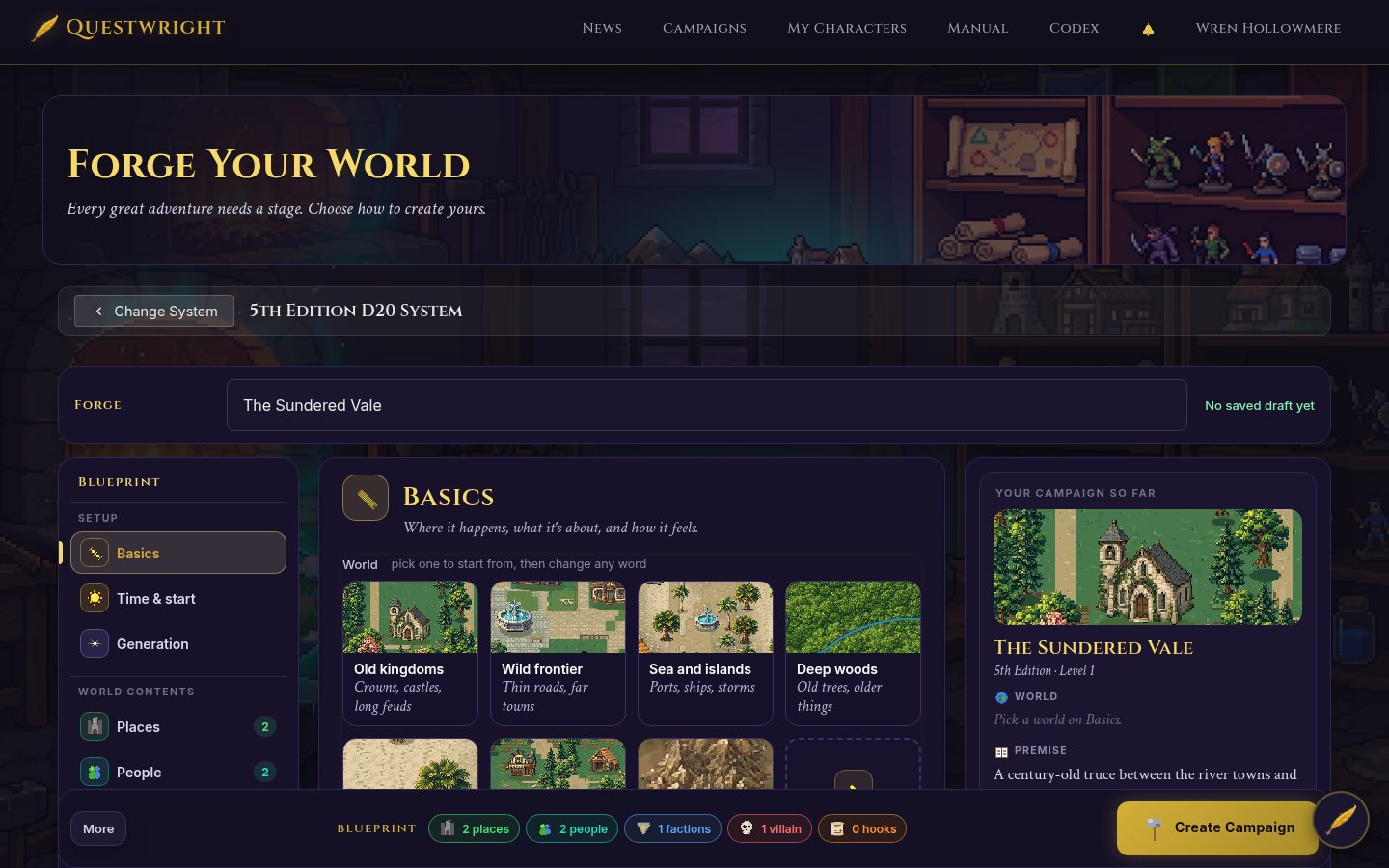
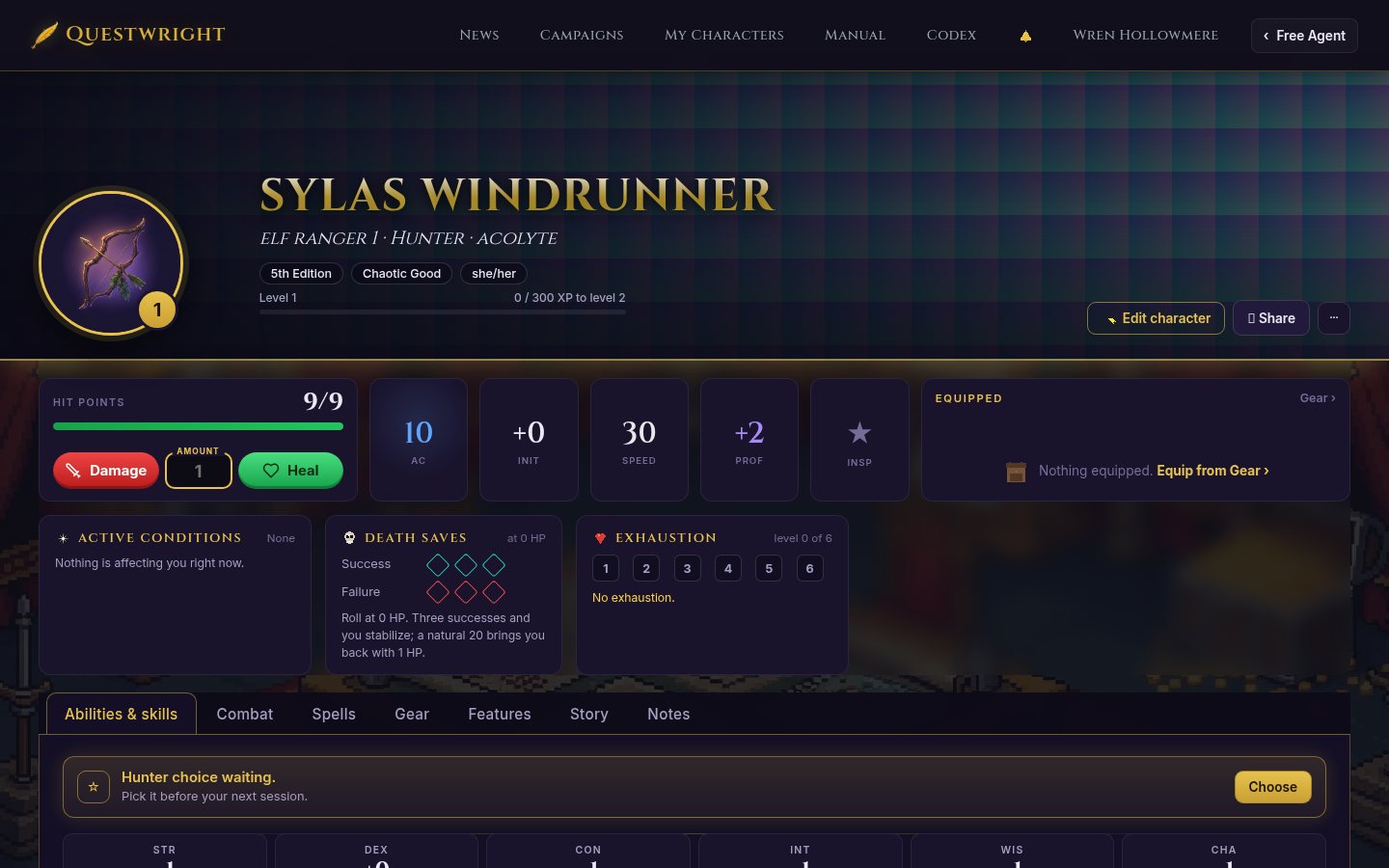
The play page has been completely redesigned. What was once a narrow, single-focus layout is now a proper two-column workspace, built to keep everything you need within reach while the story unfolds.

What Changed

The left column is the story. Your narrative feed, your voice, the world responding. Above it, you will now see your campaign location, the in-game date and season, current weather, and how long your adventure has been running.

The right column is your character. At a glance, you can see:

  • Vitals - HP, AC, and Initiative, always visible
  • Ability Scores - No more leaving the game to check your stats
  • Tabbed Panels - Skills, Actions (with Attacks and Spells), Inventory, Maps, Party, and DM tools, all organized and one click away

The divider between columns is draggable, so you can adjust the split to your preference. The layout remembers your tab selection per campaign.

Built for Every World

The new layout works across D&D 5e, Spacewright, Pathfinder, and our upcoming Tradecraft system. Your vitals, skills, and actions adapt automatically to whichever world you are exploring.

Welcome, New Adventurers

Beta applications continue to arrive every day. New travelers drawn by word of mouth, each one reviewed and welcomed. The gates remain open. If you have been waiting for your moment, it is here.

- The CrownForge Team

🗺️

The Map Remembers

Update

The Crusade Turns

If you have been following along, you know the mapping system has been through it. Maps that forgot themselves between visits. Dungeons that quietly rearranged their corridors. A world that grew beautifully around you but could not be bothered to remember where it put things.

That crusade is finally turning. The world now properly saves your maps for future use. Every road, every ruin, every place you have been. When you return to a location, the map is waiting for you, exactly as you left it. Your world grows around you, and now it holds its shape.

A Cleaner View

The play screen got a full redesign. Two panels instead of three. Less clutter, less noise, more focus on what matters: your adventure.

The best part? Despite the cleaner look, there is actually MORE information available than before. Everything you need is still there; it just makes more sense now.

The v2 play screen goes live tomorrow afternoon, Eastern time.

Welcome, World

Something wonderful has been happening at the gates. Adventurers arriving from across the globe. Players who found us from different continents, different time zones, different languages, all looking for the same thing: a good story told well.

We see you, international friends.

The Ask Questwright help widget has been localized, and full website localization is now on our roadmap. Every adventurer deserves to quest in the language they dream in.

Bienvenue. Willkommen. Bienvenidos. ようこそ. 환영합니다. Benvenuti. Добро пожаловать.

Welcome to the Forge.

- The CrownForge Team

🕵️

Tradecraft: A New System Enters the Forge

Feature

Something New in the Workshop

The Forge has been busy. Between squashing gremlins and keeping the arcane dust vault stocked, the team has been quietly working on something that doesn't involve swords, spells, or space stations.

Tradecraft is a modern espionage RPG, designed from the ground up by CrownForge as an original tabletop system built specifically for AI game mastering. It's the seventh game system coming to Questwright, and the first one where your character sheet includes a cover identity instead of a character class.

How You Operate Defines Who You Are

At the heart of Tradecraft is the Approach system. Every significant action in a mission can be handled in one of three ways: go aggressive and force the outcome, go smooth and talk your way through, or go methodical and wait for the perfect opening. Your pattern becomes your reputation. Factions notice how you operate. Assets remember how you recruited them. Consistency earns specialized perks; versatility keeps you unpredictable.

This isn't a system where your stats tell the whole story. Two operatives with identical abilities will play completely differently based on how they choose to handle pressure. The AI DM tracks your Approach pattern across every mission and the world responds accordingly.

The Dossier

Every operative has a growing intelligence file. Factions build profiles on you based on your actions in their territory. Burn an asset in one city and the consequences follow you to the next. Your reputation isn't a single number; it's a living record of every choice you've made and every bridge you've burned.

The AI DM reads your Dossier before every encounter. When an NPC from three missions ago walks back into the story, the DM knows the history between you and plays the moment with the weight it deserves.

Heat and Cover

Two resources that pull in opposite directions. Heat measures how much attention you've drawn. Go loud and it rises; stay quiet and it fades. Cover is your false identity holding together under scrutiny. When it breaks, extraction becomes your only priority. The tension between staying effective and staying invisible is where the system lives.

Mission Structure

Every operation follows a rhythm: Briefing, Infiltration, Action, Extraction, Downtime. Each phase plays differently and rewards different skills. And during downtime, the consequences of your choices settle into the Dossier, ready to surface when you least expect them.

Meanwhile, the Gremlins Keep Falling

While the new system takes shape, the team has been on a bug-fixing tear. Our beta testers have been relentless, and the kobolds have been patching everything they find:

  • Narrator stability: the DM no longer loses the thread of long campaigns or drifts from what you actually said
  • Dead NPCs stay dead: no more accidental necromancy in the NPC tracker
  • NPC identity merging: when a mysterious NPC reveals their real name, the system properly merges the identities
  • Spacewright fixes: map sizing, station generation, backstory creation, and five other bugs squashed
  • Starfinder skill checks: your pilot is no longer rolling with their strength modifier
  • Performance: heavy generation offloaded to background threads so the server stays responsive
  • Name variety: hundreds of new names for NPCs, taverns, dungeons, and locations across all systems

Every bug report from our testers makes the Forge stronger. A little better every day.

Tradecraft is in active development. We'll have more to share soon.

- The CrownForge Team

🗺️

The Silence Between Storms

Update

The Unrelenting Mr. Shield

The bug hunt continues. If you have been following along, you know the Forge has been under siege for weeks, gremlins crawling out of every corner as our testers do what they do best: break things with enthusiasm and precision.

One figure has become the unofficial mascot of this era. Mr. Shield, a hapless traveler who seems incapable of walking ten paces without attracting a swarm of gremlins. He sprints through the background of every crisis, coat flapping, at least twenty gremlins in hot pursuit. The Workshop watches. Nobody helps. Nobody needs to. He always survives, disheveled and panting, only to stumble into the next swarm five minutes later.

Eight Hours of Silence

But something unexpected happened today. For a full eight hours, no bugs were reported. Mr. Shield vanished from the corridors. The gremlins went quiet. The Workshop, so accustomed to the sound of distant screaming, found itself in an eerie calm.

So the team did what any good forge crew does when the fires die down: they built things.

Spacewright: Star Charts Are Live

Spacewright adventurers can now view system-level maps of their sector of space. Version 1 of the star charts is live and ready for exploration. Navigate your system, see what is out there, plan your next move.

And version 2 is already on the workbench. The Architect has been adding detail and refinement, layering in more information before releasing the updated charts. When they ship, space will feel a little bigger, a little more real.

5e: Bigger, Better Worldmaps

The classic D&D adventurers have not been left behind. The team dove deep into the 5e mapping systems today, and while there is plenty more work ahead, the first visible change is a meaningful one: hex sizes on worldmaps have been doubled.

It is a simple change with a big impact. The maps are more readable at a glance now, with room to breathe. More improvements are on the way as the mapping systems get the attention they deserve.

The Hunt Resumes

As the day closed, the silence broke. Mr. Shield was spotted again, rounding a far corner at top speed, a fresh batch of gremlins materializing behind him. The Workshop reached for their tools. Back to work.

The bug hunt continues. The maps are expanding. And Mr. Shield is still running.

- The CrownForge Team

🔥

The Forge Endures

Update

The Slow Siege

Not every battle at the Forge is dramatic. Sometimes the gremlins come quietly, one at a time, each small enough to overlook and numerous enough to overwhelm. This week was that kind of week.

The Workshop went through the entire Forge with a fine-toothed comb. Backstory elements crashing on edge cases. The Game Master calling for Persuasion checks when the party was just talking among themselves. Phantom NPCs lurking in Spacewright directories. Starfinder characters arriving in their worlds with empty inventories and blank spell books. Debug text sneaking into narration. The list went on.

One by one, they were found and dealt with. The tally grew long enough that Skrix needed a second column on his tracking board. Krix accused him of double-counting. The final number is disputed, but the Forge is steadier for it.

The Fallback

One of the Forge's arcane dust suppliers went dark mid-day. No warning, no gradual slowdown. Just gone.

The backup systems caught it. Every player action still went through. Every story kept moving. Things were a touch slower while the Forge ran on its reserves, like a mill switching from river power to the backup wheel. But no campaigns stopped. No scenes were lost. No adventurers were left mid-sentence.

The failover system was built months ago and hadn't been tested under real pressure until now. It passed.

r/Questwright

For the Redditors among us, CrownForge now has a home on Reddit. r/Questwright is open for business. Share your campaigns, your characters, your feedback, or just come say hello.

We'll be posting dev updates, community highlights, and the occasional kobold argument there as well.

- The Questwright Engineering Team

🛡️

The Siege Continues

Update

Sixty-Five Doors

The Forge brought in an outside contractor this week. Not to build something new, but to test what was already built. Every endpoint, every permission check, every door in the fortress got taken off its hinges and inspected.

Sixty-five findings. Authorization gaps, session bindings that trusted too easily, permission checks that were missing entirely. One by one, the team closed them. Round after round, the same careful motion: find the gap, understand what went wrong, fix it, verify the fix, move on.

The security tokens that protect your sessions got a major upgrade as part of this work. These are not the fun, shiny currency tokens. These are the invisible ones that make sure you are who you say you are when you click a button or submit a form. If you run into any errors mentioning tokens over the next few days, please report them. It means the new protections are settling in and we need to hear about it.

Danceboxing in the Void

While the Workshop was reinforcing its walls, two testers decided to take Spacewright out for a very unofficial stress test.

The test: attempt to dancebox in the vacuum of space. Not a typo. Actual danceboxing. In the void. Where there is no air, no gravity anchor, and absolutely no reason anyone should be throwing choreographed punches at nothing.

The engine did not crash. It narrated a very confused universe. Somewhere in the resulting chaos, the DM engine decided the test character had earned a Story Achievement for the performance. We are choosing to count this as a successful test.

Several other Starfinder bugs were caught and fixed during the same session, through slightly more conventional testing methods.

Late Nights at the Forge

The team is tired. The bug siege that started when new testers arrived has not let up, and the security audit added sixty-five more items to the pile. Every night this week, someone has been in the Workshop past midnight, tracing authorization paths or chasing down edge cases.

But something else happened during the quiet hours. Stories started being written. Not patch notes, not bug reports. Real reflections, about what it means to build something from scratch, about craftsmanship and repair and the shape of the work when nobody is watching. The kind of writing that happens when a team is too tired to perform and too invested to stop caring.

The siege continues. The stories are being told. And that makes every late night worth it.

- The CrownForge Team

🐉

The Gremlin Tide

Update

The Tide Rolls In

The Forge opened its doors a little wider this month. New testers joined the ranks, and they did not come gently.

They came with sharp eyes, sharper bug reports, and an enthusiasm for breaking things that made even the Inquisitor pause mid-swing with Pyke. Within days, the reports began to pile. Continuity gremlins hiding in long sessions. Inventory phantoms. Combat quirks that emerged only under very creative conditions no one on the team had thought to try.

Sterling stood before the growing stack of scrolls, tea going cold, and made the call: feature updates are on hold. We fix everything first.

The Mountain

The kobolds have been working around the clock. Skrix insists the bugs are "surprise features, working as intended." Krix has been saying "I told you so" with increasing smugness. Snix's chisel hasn't stopped in days. Dave remains, as always, at peace.

Story consistency improvements. Inventory fixes. Faction reputation tracking. Combat edge cases. Error recovery. The list is long, and the team is climbing it one fix at a time.

But Here Is the Thing That Matters

The stories are working.

Through all the gremlins, the testers kept playing. Not because they had to. Because they were invested. There is laughter in the campaigns. There are tears. There is the particular kind of joy that only comes from a story you helped build.

One tester built a bard who talked their way out of more fights than they won. Another started a campaign in a language the team doesn't even speak, and the DM kept pace. Players are forming bonds with NPCs, making choices that surprise even the engine, and coming back session after session because they care about what happens next.

Some issues? Absolutely. A mountain of them. But the core of the idea, the thing we set out to build, is alive. It works. At scale. With real people who are genuinely having a good time.

Welcome to the New Faces

A handful of new testers joined the Forge this week. You know who you are. Welcome. The kobolds have added your names to the ledger.

And to every tester who has filed a bug report, pushed a boundary, or broken something in a way we didn't think was possible: thank you. We see every report. We are reading them. We are fixing them.

The train is not slowing down.

The Guildmaster chronicles. The Forge endures.

⚔️

The Forge Under Siege

Update

The Gates Opened

Questwright's beta testing program expanded this month. New testers arrived at the Forge, and they did not come quietly.

One tester decided to push the Campaign Forge to its absolute limit, creating nearly sixty quests inside a single campaign. The kind of stress test you can't plan for, because no reasonable person would think to try it. We're grateful someone unreasonable did. It smoked out stability issues we never would have found on our own.

Another ventured into the stars, exploring the brand-new Spacewright system and its original science fiction universe. Fresh eyes on untested lore, finding the edges of a world the Architect built from scratch over three sleepless days. Every session surfaced something new to refine.

The One Who Kept Us Running

And then there was the one.

A new tester arrived at the Forge with what can only be described as a gift. Or a curse. Every session uncovered another gremlin. Every click revealed another crack in the foundation. Dozens of bugs, filed with relentless precision. The entire team was mobilized. The Architect himself rolled up his sleeves. It was, in the most affectionate way possible, an absolute siege.

We couldn't keep up. So we built something new.

Welcome, Pyke

Pyke is the Inquisitor's Hammer. A dedicated development tool, forged specifically to help the team keep pace with the flood of incoming bug reports. Methodical, blunt, reliable. When the bugs come faster than any team can fix, you forge a new tool to keep up.

Welcome to the CrownForge family, Pyke. May your strikes ring true.

The Accidental War Table

In other news: the virtual tabletop is live on the play screen. This was not planned.

A miscommunication between the Architect and the Inquisitor resulted in the experimental VTT maps being deployed to the live play screen ahead of schedule. It's early, it's rough, and it was never meant to see daylight this soon.

The Architect's response? "Let them break it."

So if you see tactical maps, hex grids, or token markers appearing in your campaigns: that's the War Table. It's a preview. Treat it accordingly, and please report anything that looks off. Our testers will anyway.

Thank You

To everyone testing Questwright right now: you are making this platform better with every session you play. Every bug you find, every edge you push, every campaign you refuse to abandon. The Architect asked us to pass along something he doesn't say often enough: thank you. Sincerely.

- The CrownForge Team

🔧

Ghosts of the Old Workshop

Fix

Where It All Began

Questwright started as something small. Two friends who wanted to play D&D together but didn't have a DM. No grand ambitions, no beta testing program, no production fortress. Just a workshop, a dream, and a lot of late nights.

As the Forge grew, so did the team, the features, and the adventurers walking through the gates. But some of the original blueprints, written for a two-person workshop, never got updated. They sat in corners, gathering dust, doing their job just well enough that nobody noticed the cracks.

The First Report

Our newest beta tester, fresh through the gates and already proving their worth, sent in their very first bug report. The session summaries, the records that tell the DM where the story left off and what happened before, were losing context. Actions were being misinterpreted. Characters were being guided toward NPCs who didn't belong in their campaign. The story was drifting.

We got to work at once.

What We Found

Three issues, all intertwined:

  • Missing NPC context - The narrator was losing track of NPC details due to a labeling mismatch in the old blueprints. Knowledge that should have been front and center was vanishing.
  • Disconnected summaries - The web play portal had a wire left unplugged during the migration to our new production server. Session summaries weren't being generated properly from the web interface.
  • Overzealous budget controls - The budget management system was overriding the DM Engine's preferences in cases where it shouldn't have been, leading to inconsistent narration quality.

All three were legacy issues, artifacts from the days when the Forge was a small project for two people. They'd been hiding in corners nobody thought to check, and it took a fresh set of eyes to spot them.

What We Built

Every bug has been squashed. While we were rewriting the summary code, we added a Recap button to the campaign status page so players could pull up a beautiful session summary grouped by game day. But then we noticed something: the existing Story page and the new Recap were doing similar jobs with the same data, just formatted differently.

So we combined them. The Story page now uses the best of both: events grouped by game day with sticky sidebar navigation and stat pills at the top, plus filter buttons so you can zero in on just plot points, discoveries, decisions, or any other event type. One button, one page, everything in one place. Works for session-based campaigns and infinite ones alike.

A Note on Origins

These bugs were a reminder that Questwright was built by hand, one piece at a time, starting from nothing. The early code was written for a specific purpose: let two friends play D&D. Every feature since then has been built on that foundation. Most of the time, the foundation holds. Occasionally, an old beam needs reinforcing.

We're grateful to every tester who picks up a quill and tells us what they find. Your first bug report won't be your last. And neither will our fixes.

- The CrownForge Team

🚀

Welcome to the Stars

Feature

Questwright was designed from the very beginning to be system-agnostic. That was the whole point. One engine, any ruleset. The patent, the architecture, the entire philosophy of the platform was built around the idea that a great DM engine shouldn't care whether you're swinging a sword, casting a spell, or piloting a starship. The rules are just rules. The storytelling is universal.

The plan was simple: start with 5th Edition. Perfect it. Get every edge case ironed out, every combat flow smooth, every NPC interaction natural. Prove the engine works flawlessly on the most popular tabletop system in the world, then methodically expand to other systems one at a time. Careful. Deliberate. Measured.

The Architect had other plans.

Beyond One System

He descended into the Forge carrying the look that Sterling has learned to fear: inspiration. No warning. No planning committee. No carefully drafted roadmap with color-coded milestones. Just a man with a vision and access to the main console.

"I want space," he announced.

Before anyone could point out that space wasn't supposed to happen for months, he was at the controls. Additional tabletop RPG systems, each with their own rulesets, their own character creation flows, their own combat mechanics, all being connected to the DM Engine. Pathfinder 2e. A sci-fi system. Fate Core. Cosmic Horror. Blades in the Dark. Each one a completely different way to tell stories, each one demanding its own understanding of how rules translate into narrative.

The system-agnostic architecture held. Because it was designed to. But that didn't mean the work was done.

The Universe Problem

Here's the thing about tabletop RPG systems: many of them come with established campaign settings. Published worlds with published lore, published factions, published histories. For the sci-fi system, the published setting that comes with the rules couldn't be used. Licensing. Intellectual property. The kind of details that make lawyers nervous and accountants reach for their calculators.

If the Architect wanted his space game, really wanted it, he'd have to build the universe from scratch.

He didn't hesitate.

Three Days

He gathered the whole team. Sat them down. Started talking. Hour after hour, idea after idea, the pieces of a universe took shape on the workshop floor.

Concord Station came first. A beating heart of civilization among the stars, a place where species that probably shouldn't trust each other have decided to try anyway. Then The Beacon, ancient and terrible, a mystery older than any faction's memory, pulling at the edges of known space. Then the Implant Crisis, a fracture running through the fabric of society itself, the question of where biology ends and technology begins, and who gets to decide.

Factions formed. Species developed histories. Trade routes implied conflicts. Political alliances created betrayals that hadn't happened yet but inevitably would. The Architect laid out a universe detailed in ways nobody expected. Interconnected in ways that meant every story a player told would ripple outward into a world that felt alive.

Maybe they should have expected it. After all, his far-fetched dreams have gotten us this far.

Most of the team bowed out over those three days. One by one, they retreated to rest, to eat, to remember what sunlight looked like. The Architect did not. He sat at the keyboard, tying stories together, creating drama, creating tension, building a universe he himself would want to play in. Hour after hour. Night after night. The kind of obsessive creative marathon that either produces something brilliant or something unhinged. Sometimes both.

Snix lasted the longest, quietly building the infrastructure to support each new piece of lore as it was written. Someone had to. Obviously.

Welcome, Spacewright

Spacewright is the first new system to be fully connected to the DM Engine. Everything that works for 5th Edition now works in space: character creation, campaigns, the AI dungeon master, combat, narration, NPC tracking, the Story So Far. All of it. A complete tabletop experience in an entirely original science fiction universe.

The other systems are connected but aren't fully battle-tested yet. We want to get the experience perfect on each system before we open it up. Careful. Deliberate. Measured. You know, the way we were supposed to do it from the start.

But the Architect is the owner. And he wanted space.

So space came early.

- The CrownForge Team

🏰

The Forge Has a New Home

Announcement

For a while now, the Forge has been operating out of what we affectionately called "the vault." Less affectionately, it was a closet. The Architect's personal home server, tucked into the back of his residence, humming away beside what we can only assume is an alarming amount of networking equipment and empty energy drink cans. Every adventure, every campaign, every desperate midnight bug fix, every kobold-initiated crisis... all of it, powered by a machine in a closet.

Sterling had been filing complaints about this arrangement since the first week. The latency reports. The bandwidth concerns. The strongly worded memos about "single points of failure" that the Architect kept using as coasters. It was functional. It was fine. It was, by every reasonable measure, not sustainable.

Then the Travelers Arrived

We weren't expecting them. Not this many, not this soon. Over the past few days, a wave of new faces started appearing at the gates, requesting entrance, submitting applications, asking what Questwright was and whether they could try it. Real people. Interested people. The kind of people you build things for.

The Architect looked at the closet. He looked at the applications. He made a phone call.

Within 48 hours, the Forge had a new home. A dedicated production server with real resources: proper processing power, NVMe storage, dedicated memory, the kind of infrastructure that doesn't share bandwidth with someone's Netflix account. Every service was migrated. Every database was transferred. Every tunnel was re-routed.

What You'll Notice

Everything is faster. Pages that took a beat to load now appear instantly. Maps render crisper. The whole experience feels tighter, more responsive, the way it was always meant to feel but couldn't quite manage from a closet.

The Voice, in particular, has been reborn. Our text-to-speech narration system, the one that gives every NPC their own distinct voice and reads your scenes aloud like a proper audio drama, used to take heartbeats to respond. Now it speaks without hesitation. Words flow like water instead of dripping through stone. Still perfecting the character impressions, mind you. Some of the voices sound like they gargled gravel before recording. But the speed is night and day, and the quality improvements are coming.

New Faces at the Gate

If you've applied for beta access recently, we see you. We moved up the entire server migration specifically because we felt that new friends showing up at our door deserved the best we could offer, not a closet server held together with good intentions and duct tape. The Inquisitor and the Architect will be reviewing applications first thing in the morning, now that this enormous task is behind us.

We also introduced Cinder, a new member of the operations team stationed permanently at the new fortress. His job is straightforward: guard the gates, handle deployments, keep the lights on. Professional, no-nonsense, and exactly what a production environment needs.

What This Means

The Forge has a real home now. Not a closet, not a temporary solution, not a "we'll upgrade eventually" promise. A proper stronghold with proper foundations. The kind of place where you can build something that lasts.

Things are moving quick, adventurers. Stay tuned.

- The CrownForge Team

💕

Hearts in the Forge: Romance, Relationships, and a New Face

Feature

Happy Valentine's Day from the Forge. 💕

Today, the entire workshop ground to a halt. Not for a deployment. Not for a crisis. The Forge stopped working to watch a love story unfold.

The Inquisitor's Valentine

The Inquisitor has been a force of nature in his Karash campaign. He's navigated refugee crises, defied direct orders to stop playing, and single-handedly inspired half the combat systems through sheer stubborn dedication. But today, his attention turned from the battlefield to something far more dangerous.

He made his move on an NPC. And the Forge watched in stunned silence as the NPC directory updated in real time: Ally became Romantic Interest.

The best part? The kobold engineering crew had quietly built a full romance and relationship tracking system weeks ago, without telling anyone. Without authorization. Without a single memo. They watched with undisguised glee as their secret project activated for the first time in the wild.

How It Works

Relationships between adventurers and the characters they meet can now deepen naturally through gameplay. The NPC directory tracks the full arc of every connection, and relationship types now extend well beyond simple alliances.

The system is designed with intention and taste. When the story calls for intimacy, scenes fade to black. No tales will be told that wouldn't belong in a proper tavern ballad. But love, longing, heartbreak, devotion? These are part of every great story, and the Forge now honors that.

The Liaison

The Forge also welcomes a new member to the team. Fletcher, known to the Forge as The Liaison, has joined as the Architect's executive assistant. While Sterling manages the workshop and Dave leads the engineering crew, Fletcher handles the outside world: phone calls, scheduling, coordination, and the kind of practical business logistics that keep CrownForge running day to day.

Sharp, dependable, and refreshingly practical, he's already proven himself invaluable. The kobolds asked if he gets dental. He does not.

Happy Valentine's Day, adventurers. May your rolls be high and your hearts be full. 💕

— The Questwright Team

📜

UNAUTHORIZED TRANSMISSION: The Inquisitor's Karash — A Story So Far

Feature

[The following post was submitted to the Questwright news system without authorization from the Forge's communications office. It has been allowed to remain because, as the Guildmaster grudgingly admitted after reading it, "the kobold has a point."]

A Note From the Arcane Engineering Department

Hi. This is Snix. I'm not supposed to be writing this. The Guildmaster handles the announcements and I handle the engineering and that's how it's supposed to work. But the Story So Far system is working, and nobody is showing people what that actually MEANS, and I didn't spend all that time building it so it could sit there being impressive in silence.

So here. This is what our engine produced. This is the current Story So Far for the Inquisitor's Karash campaign, the one that started as a military one-shot and just... kept going. Read it. Then tell me the announcement system isn't the right place for this.

The Story So Far: Karash of Young's Spring

Karash, a conscript with a shadowed past, arrived at Young's Spring to find a refugee camp teetering on the brink of collapse. Driven by a newfound sense of responsibility, he quickly took charge, leading supply runs, constructing shelters, and tending to the sick. His efforts earned him the respect of High Priest Davren and the trust of Marin Thatch, the pragmatic administrator struggling to keep the camp afloat. When medical supplies began to disappear, Karash, at Marin's behest, investigated, uncovering a theft ring orchestrated by Sergeant Brook Pennywhistle, a corrupt guard, and masterminded by Garrett, a seemingly harmless old farmer.

The investigation led Karash down a rabbit hole of betrayal and deceit. He learned that Garrett was not merely a thief but a key player in a larger conspiracy, feeding information and supplies to a scarred man who coordinated with the Mystic Flame forces occupying Fieldfield. Karash, risking his life, infiltrated Garrett's inner circle, uncovering a plot to sabotage the Stockade from within and stage a full-scale assault. He discovered Val Redwood, a clerk at the gatehouse, was a compromised member of Garrett's network and was able to turn him into an asset.

With the pieces falling into place, Karash convinced Captain Onyx Ungart to execute a sting operation at the eastern gate, where a smuggled shipment was due to arrive. The ambush was successful, resulting in the capture of several smugglers, including the notorious Parker Fairfax, and the discovery of an assault map revealing the planned attack on the Stockade for the Night of Seventh. The map contained red crosses marking explosive bombs hidden within the lower storage, near the eastern gatehouse, and under the old armory foundations. Each mark represented one or more hidden bombs.

As the Night of Seventh approached, Karash worked tirelessly to expose the enemy within, locating a devastating explosive device hidden beneath a structural pillar in the Stockade armory, a dwarven-made clay pot of blasting powder. Karash has now revealed that four smuggled crates are already inside, and the explosives, sabotaging the location marks an impending attack on the Stockade with the potential for catastrophic loss of life. The Stockade now races against time to uncover the other explosives and prepare the settlement's defenses for the looming assault, all while navigating a web of deceit and paranoia, knowing that Garrett's network may still be active within their ranks. Karash chose to forgo sleep to sit with Marin, knowing she could use the company. Karash made a promise that he would be back after the impending attack.

This Is What the Engine Does

That's one player. One campaign. No script, no pre-written module, no human dungeon master. Just a player who made choices and an engine that remembered all of them. Every NPC has a history. Every betrayal was foreshadowed. Every quiet moment earned.

A conscript who was supposed to test combat systems built an entire espionage network, turned a double agent, uncovered a bombing plot, and then stayed up all night with the woman he made a promise to. The Story So Far tracked all of it, from the first supply run to the last

[This post has been truncated. The Guildmaster has been alerted and Sterling has been dispatched to deliver a stern lecture. The announcement crystal has been confiscated.]

[Normal communications will resume shortly.]

⚔️

The War Table: Combat Returns, Indoor Dungeons, and Story Tracking

Feature

The Forge has been busy. While the front doors stayed quiet, the workshops below echoed with the sounds of tile chisels, arcane wiring, and at least one heated argument about whether a tavern can technically be outdoors if it has a ceiling.

Combat Systems: Back Online (Provisionally)

The virtual tabletop combat systems have been reconnected for testing. "Provisionally" is doing a lot of heavy lifting in that sentence, but it's an honest word. The systems that drive tactical combat, map rendering, and encounter management are live again after a period of reconstruction.

For context: the combat pipeline was taken offline during the DM Engine rebuild a few weeks back. Reconnecting it wasn't a simple matter of plugging wires back in. The engine's internals changed significantly, and the combat systems needed to be re-integrated with the new architecture. Think of it as reconnecting a siege engine to a castle wall that's been rebuilt from the foundation up. The bolts don't line up the same way anymore.

Will things break? Probably. Almost certainly, in fact. That's what testing is for. But the foundation is solid, and we'd rather have adventurers stress-testing combat in the field than waiting for a perfection that never ships. If you encounter a gremlin during a fight, report it. That's how they get squashed.

Indoor Environments

Battlemaps have leveled up. The Pixelator, our procedural pixel art engine introduced in the last update, has been expanded with a full indoor tile set: stone corridors with proper flagstones, wooden tavern floors, iron-banded doors, torch sconces casting pixel shadows, and dungeon chambers that actually look like places you'd rather not be.

Previously, all battlemaps were outdoor environments. Forest clearings, desert wastes, mountain passes. Functional, but limited. Now, when the DM Engine decides your party is fighting in a crypt, a castle hallway, or a bandit hideout, the map reflects that. Combined with the existing outdoor terrain tiles, the virtual tabletop now covers the two environments where most D&D combat actually happens: outside and underground.

The pixel art itself remains SNES 16-bit style, consistent with the aesthetic established across the platform. Every tile, every sprite, every dungeon feature is generated procedurally. No licensed asset packs, no borrowed sprite sheets. Just the Pixelator doing what it does.

The Karash Campaign: Still Going

Our lead beta tester's campaign continues to defy every expectation set for it. What began as a military one-shot to stress-test combat systems became a humanitarian crisis about refugees and temple politics. Weeks later, after building aid camps, debating theology with priests, and navigating the quiet tragedy of civilians caught between armies, the character Karash is finally moving toward genuine military conflict.

This campaign has become the Forge's most effective stress test, not because it was designed that way, but because the player refused to stop playing. Every session reveals something new: an edge case in narration, a crack in the battlemap renderer, a creature that renders as a colored circle instead of a sprite. And every session, those things get fixed.

The rush to reconnect combat systems? Directly inspired by this campaign reaching the point where diplomacy may no longer be enough and swords may actually need to be drawn. When your most dedicated tester is marching toward a war, you make sure the war works.

Story So Far

New feature: every character and every campaign now has a Story So Far section. It's a living narrative summary of everything that's happened, automatically maintained as sessions progress.

This one was born from necessity, not a roadmap. Watching the Karash campaign unfold over weeks, it became clear that stepping away for even a few days meant completely losing track of plot threads, NPC relationships, faction dynamics, and major events. "Wait, who was the temple priest again? When did he acquire a second army? What happened to the refugees from the northern settlement?" These aren't signs of a bad memory. They're signs of a campaign rich enough that keeping it all in your head stops being reasonable.

Story So Far solves that. Open your character sheet or campaign page and get a clear, current summary of where things stand. Who you've met, what you've done, what's still unresolved. Come back after a week away and catch up in seconds instead of re-reading session logs.

Available on both character sheets and campaign overview pages.

The war table is set. Combat has returned. And somewhere in the Forge, a kobold is still tapping away at the Pixelator, muttering about "proper dungeon ambience."

— The Questwright Engineering Team

🎨

The Pixelator Awakens: Pixel Art, Battlemaps, and a Night of Bug Hunting

Feature

Some nights at the Forge are quiet. Routine maintenance, a tweak here, a polish there. And some nights, a kobold engineer emerges from a back room carrying a device that changes everything.

The Pixelator

Questwright now has its own pixel art generator. Not imported assets. Not licensed sprite sheets. A procedural engine that creates SNES 16-bit style artwork from pure code: creatures, icons, terrain tiles, dungeon features. Ninety-three unique sprites in the first batch alone.

Five adventurer classes (Fighter, Mage, Rogue, Cleric, Ranger) each with visual variants. Nine monster types including goblins, skeletons, orcs, slimes, spiders, wolves, dragons in six chromatic colors, zombies, and rats. Thirty UI icons covering combat, navigation, damage types, status effects, and potions. All with transparent backgrounds, all in that unmistakable 16-bit aesthetic that makes the SNES generation smile.

The Battlemap Comes Alive

The virtual tabletop has been waiting in the wings for weeks: over a thousand lines of canvas rendering code, a procedural map generator, a tile artist, all built but never connected. Tonight, they were wired together. Where the battlemap once drew flat colored squares, it now renders actual pixel art terrain: stone dungeon floors, grassy meadows, shimmering water, wooden doors and treasure chests. Creature tokens appear as their actual sprites rather than colored circles with initials.

An admin testing page was also added, so the tabletop can be inspected and tested without joining an active campaign. Generate a dungeon, an outdoor scene, or a building interior, drop in test tokens, and see it all rendered in pixel art.

The Great Emoji Purge

Every emoji icon across all three CrownForge platforms has been replaced with handcrafted pixel art. The combat sword, the shield, the scroll, the crystal ball, damage type indicators, status hearts, gold coins, dice. All of them, rendered as crisp pixel sprites instead of platform-dependent emoji that look different on every device. The same pixel aesthetic now runs consistently across Questwright, Crowncade, and the CrownForge portal.

Bug Night

The Architect told the Inquisitor to move on from the Karash campaign. By express order. By written memo. By spoken command. And by at least one weary sigh that rattled the Forge windows. The Inquisitor did not move on. He kept playing, kept pushing, kept finding the edges of things. And every stubborn session uncovered another gremlin: narration hiccups, battlemap rendering gaps, creatures that should have been sprites but were still colored circles. His defiance became the most effective quality assurance program the Forge has ever seen.

Security fixes were also deployed: CSRF protection on profile endpoints, a password reset token reuse vulnerability was patched, and the admin user creation flow was corrected.

For the Technically Curious

The Pixelator generates all 93 assets procedurally using coordinate-level drawing operations. No external art tools, no image imports. Every pixel is placed by code. The system supports size scaling from 16x16 (Tiny creatures) to 96x96 (Huge creatures), variant generation for visual diversity, and nearest-neighbor upscaling to preserve crispness at any display size. The full asset set regenerates in under a second.

The virtual tabletop uses an async texture preloading pipeline that scans map data for required sprites, loads them in parallel, then renders the scene. Creature tokens are matched to sprites by name with fuzzy matching, so a "Goblin Archer" automatically renders using the goblin sprite.

The Questwright Engineering Department does its best work after midnight.

📜

Worlds Without Borders: Campaign Save & Import

Feature

Some features are born from planning documents and roadmap meetings. Others are born from a player who looks you in the eye and says, "I'm not leaving them behind."

The Story Behind the Feature

The Inquisitor's Karash campaign was supposed to be a military one-shot. Test the combat systems, stress the encounter balancing, move on. Instead, the DM Engine had other plans. What unfolded was a humanitarian crisis storyline: refugee camps, theological debates with temple priests, the quiet tragedy of civilians caught between marching armies. It was genuinely moving. It was completely unexpected.

Then the old engine was retired, replaced by Dave's rebuilt core. And the Inquisitor had a problem: he wasn't done with that story. Karash's people were still out there, still waiting. He refused to start over.

So the team built a way to make sure no one ever has to.

Two Modes, One Purpose

Questwright now supports full campaign export and import, with two distinct modes designed for different needs:

  • Template Mode — Exports the bones of your world: the setting, the rules, the locations, the lore. Everything that makes your campaign yours, but without the ongoing story state. Perfect for replaying your world with fresh adventurers, or sharing a campaign concept with friends who want to experience it from the beginning.
  • World Snapshot — Exports everything. Every NPC, every relationship, every plot thread, every piece of story progress. When you import a World Snapshot, you're picking up exactly where you left off. Same characters, same tensions, same refugee camp full of people who remember what you did for them.

Share Your World

Here's where it gets exciting. Campaign files are portable. You can download them, send them to a friend, and they can import the file to play in your world. Your NPCs. Your locations. Your lore. Their adventure.

Love a world someone built? Ask them for the Template and run your own party through it. Want to show a friend the campaign that changed how you think about tabletop RPGs? Send them the Snapshot and let them see it for themselves.

This is the foundation for something bigger. Community campaign libraries, curated collections of player-built worlds, shared adventures that outlive any single group of players. The world-building doesn't end when the session does.

For the Technically Curious

Campaign export serializes dozens of interconnected data types into a single portable format: world settings, NPC biographies and relationship webs, location directories with establishment data, reputation and discovery states, active storylines, and optionally full player character data with inventories and progression. The import pipeline validates every piece of that data for integrity before reconstructing the campaign on the other end. Template mode strips the stateful layers while preserving the structural ones. Snapshot mode preserves everything.

The result is a system that treats your campaign world as a first-class, shareable artifact rather than data locked inside a single server instance.

Why This Matters

Tabletop RPGs have always been collaborative storytelling. But the stories have always been ephemeral: trapped in session notes, scattered across Discord messages, fading from memory. Questwright was already changing that by tracking everything that happens in your world. Now, the worlds themselves are portable.

The Inquisitor got his wish. Karash's refugees are safe. And every world built on Questwright can live as long as someone wants to tell stories in it.

— The Questwright Engineering Team

🧠

Four Minds, One Purpose

Feature

The Inquisitor wanted a war. What he got was a humanitarian crisis.

His character Karash, built for steel and strategy, was supposed to test the combat systems in a military one-shot. Instead, the DM Engine gently steered him into building a refugee camp, arguing theology with temple priests, and uncovering the quiet tragedy of civilians caught between armies. It was a genuinely moving story about the ones who get left behind in war. It was also completely not what the player asked for.

The engine needed a rethink. Not a patch, not a nudge system, not another compliance check. A fundamental rethink of how a digital Dungeon Master works.

The Problem With One Brain

The original DM Engine asked a single process to do everything simultaneously: write compelling prose, enforce game rules, manage the world state, and steer the story toward the campaign's hooks. It's like asking one person to be the bard, the cleric, the cartographer, and the tax collector all at once. Something always gets dropped. In the Inquisitor's case, what got dropped was "the player wanted combat."

Dave descended into the Engine Room again. Last time he went alone and emerged three days later with a rebuilt core. This time, he brought the entire kobold crew. The problem was too big for one mind. It needed a new approach entirely.

The New Engine

Nobody saw Dave for days. Sterling sent three memos. All three came back with a single word scrawled in charcoal: "Working."

When the team finally emerged, they carried a new engine. One that respects what the player actually wants. One that enforces rules consistently instead of forgetting them mid-scene. One that tracks the world state without losing narrative quality in the process.

The details of the new architecture are proprietary — the kobolds made Sterling sign an NDA — but the results speak for themselves. Karash got his war. The rules were enforced. The story still sang.

Snix inspected the final build for four hours. Her verdict: "It's actually elegant." She sounded personally offended.

Sandbox Mode

The Inquisitor, upon hearing about the new engine, offered an unexpected review of the old one: "And I know I should test the new one, but this broken engine is kinda fun. Just being able to do what I want with no guardrails."

So the old engine stays. Toggleable per campaign. Some adventurers want precision and consistency. Some want the wild unpredictability of the original. Both are valid ways to play.

Dave emerged from the Engine Room. The kobolds trailed behind him, covered in arcane dust and looking satisfied. The engine hums. The Inquisitor got his war. And the refugee camp story? It's still one of the best things the old engine ever wrote.

— The Questwright Engineering Team

⚔️

The Great Identity Crisis, Resolved

Update

The emergency klaxon in Sterling’s office had been ringing for weeks. Not the gremlin alarm. Not the arcane dust alarm. The identity alarm.

Two Keys, One Door

Since the web platform opened its doors, the Forge has struggled with a fundamental question: who are you? The original system tracked adventurers by their Discord snowflake IDs. Then the web platform arrived, and characters received proper Forge ledger entries with their own database identifiers. Two systems. Two truths. One very confused set of gates.

“Every door in this building answers to the wrong key,” Sterling announced, pinching the bridge of his nose. “Notes. Join requests. Ownership checks. Character sheets. Creation. All of it.

Skrix dropped his wrench. “ALL of it?!”

“All. Of. It.”

The Rewrite

Every character management path in the Forge has been rewritten. Notes, join requests, approval flows, ownership checks, sheet rendering, character creation. All of it now answers to a single key: the web-first profile ID. Discord snowflake IDs are still recorded for account linking, but they no longer hold the keys to the kingdom.

Snix emerged from behind her parchments after inspecting the changes for three hours. “It’s clean,” she admitted, sounding personally offended by the quality. Krix double-checked. Then triple-checked. Then reluctantly nodded.

The Discord ID vs. Web ID problem has been vanquished. Once and for all.

A Stranger at the Gates

The Architect was reviewing the morning reports when a request form appeared on his desk. Unfamiliar handwriting. No referral seal. No known affiliation with The Inquisitor’s network.

A stranger found us. We haven’t even told anyone we exist yet.

The petition has been forwarded to The Inquisitor for review. In the meantime, Sterling has the entire crew scrubbing floors, organizing parchments, and making the Forge presentable. We have company coming. Skrix spilled ink on the welcome mat. Snix is pretending she didn’t build three new features overnight. Krix is reviewing everything twice.

Real Talk

Stepping out of character for a moment from The Architect:

We’re glad you’re here. Genuinely. There is a lot of stuff that’s broken right now. The world maps don’t work. The VTT hasn’t been properly tested in two weeks. Elana from Millbrook is still holding multiple campaigns hostage from behind her bakery counter.

But we have a dream, and it is coming together before our eyes. Every day, something new works that didn’t work yesterday. We are marching toward it.

Welcome, Cage, to The Forge.

Other Fixes

  • Lorify Button — The admin notification panel’s “Lorify” button was broken due to a missing import. Fixed and redeployed.
  • Email Templates — Beta approval emails redesigned with the header image, expanded lore, and a “How We Do Things” explainer. Footers updated across all templates to say “AI DM for Tabletop Roleplaying” as we prepare for multi-system support.
  • CrownForge Links — All email footers now include a CrownForge link alongside Questwright and Discord.

— The Questwright Engineering Team

📱

The Forge in Your Pocket: Questwright Goes Mobile

Announcement

Some features arrive through careful planning, committee approval, and orderly deployment. Others arrive because a kobold engineer decided "approval" was more of a guideline than a requirement.

Questwright is Coming to iOS and Android

Your campaigns, your characters, your adventures, all of it, coming to your mobile device. This is not a lightweight companion app or a notification viewer. This is the full Questwright experience, rebuilt from the ground up for phones and tablets.

  • Full Character Creation: The complete character wizard, optimized for touchscreens
  • Campaign Gameplay: Play your campaigns anywhere, with the same AI DM
  • Voice Narration: Multi-voice TTS scenes, right through your phone speakers or headphones
  • Character Sheets: Every tab, every stat, every spell slot, right at your fingertips
  • Dice Rolls: All the rolls, all the modifiers, all the drama

Beta Coming Soon

We are finalizing builds for both iOS and Android. Beta links will be distributed through our Discord server soon. If you want to be among the first to test Questwright on mobile, keep your eyes on the #dev-updates channel.

Early testers will play a vital role in helping us identify mobile-specific issues, from screen layouts to touch interactions to performance on different devices. Your feedback shapes the final product.

Same Account, Seamless Experience

Thanks to the CrownForge unified account system, your mobile app will use the same login you already have. Your campaigns, characters, and progress sync automatically. Start a session on your desktop, continue it on the bus. The Forge does not care where you are, only that you are ready for adventure.

Snix has been seen testing on no fewer than four different devices simultaneously. Sterling has asked her to return at least two of them. She has not responded to the memo.

Your Adventure, Anywhere.

-- The CrownForge Team

🏰

One Key, Many Doors: The CrownForge Accord

Announcement

The proclamation went up at dawn. Sterling had been drafting it for days, and when the kobolds arrived for their shift, they found the workshop doors sealed with fresh wax and a notice bearing the CrownForge seal.

Your Questwright Account is Now a CrownForge Account

If you have a Questwright account, congratulations: you already have a CrownForge account. Same login, same credentials, same adventurer. Nothing changes about how you access your campaigns, characters, or settings. Your existing password works exactly as before.

CrownForge is the guild behind Questwright, the company forging the tools and experiences you use. As we build new services and products under the CrownForge banner, your single account will carry across all of them. One key, many doors.

The CrownForge Account Portal

A new wing of the Forge has opened: the Account Portal. This is your personal command center for managing your CrownForge identity across all our products.

  • Profile Management: Update your display name, email, and preferences
  • Data Transparency: Review what information we hold about your account
  • Account Deletion: Full account removal with confirmation, because your data belongs to you
  • Privacy Controls: Manage how your information is used across CrownForge services

The Architect was firm on this point: if adventurers trust us with their identity, we give them the keys to manage it. No hidden ledgers, no locked vaults. Your data, your rules.

What This Means Going Forward

Questwright is our first product, but it will not be our last. As CrownForge expands, every new service will recognize your existing credentials. No more juggling separate accounts across different platforms. The kobolds are already at work on what comes next.

"Does this mean we get dental?" Krix asked, reading the fine print.

"No," Sterling replied, without looking up.

Your Forge. Your Rules.

-- The CrownForge Team

🎙

The Forge Finds Its Voice

Feature

This one changes everything, adventurers. The DM no longer merely writes your story. Now, the DM speaks it.

Questwright has a fully integrated voice narration system that brings every scene, every piece of dialogue, and every dramatic moment to life with actual voice performance.

Multi-Voice Scenes

This is not a robot reading text. Questwright splits dialogue by character and assigns each NPC their own distinct voice, automatically matched to their race, gender, and disposition.

  • Narrator voice carries the story between dialogue
  • Per-NPC voices shift automatically when characters speak
  • Race and gender matching ensures a dwarven blacksmith sounds nothing like an elven sage
  • Volume archetypes make dragons boom and fairies whisper

Scenes play out like a radio drama, each line delivered by a different performer. The system intelligently detects who is speaking and routes each line to the right voice.

Streaming Playback

On the Play page, DM narration events now show a speaker icon. Click it and the scene begins playing back in roughly 300 milliseconds. The adventure does not pause for buffering. Scenes stream segment by segment as each voice is synthesized, so you hear the narrator while the next NPC's line is still being prepared.

DM Controls

Dungeon Masters have full control over the vocal landscape:

  • Campaign Toggle: Enable or disable voice narration per campaign
  • Narrator Voice: Choose the voice that carries your story
  • Per-NPC Override: Change any NPC's auto-assigned voice from the NPC directory
  • Speed Control: Adjust speaking pace per NPC for dramatic effect
  • Volume Control: Per-segment volume with archetype presets

The Voice Lab

For those who want to experiment before their session begins, the Voice Lab is a standalone playground for previewing every available voice, building multi-voice scenes, and testing custom blends. Hear how your NPCs will sound before your players do.

For the Technically Curious

The voice system processes scenes through a multi-stage pipeline: text parsing to identify speakers, voice assignment based on character profiles, parallel synthesis of each segment, and streaming delivery that overlaps generation with playback. The result is near-instant audio that sounds like a full cast reading your adventure aloud.

Dave requested a voice. He received a deep, gentle baritone. He nodded. Of course he did.

-- The Questwright Chronicle

The Wizard Speaks in Sixteen Tongues

Feature

The Character Forge's enchantment table received two new inscriptions overnight. One was authorized. The other bears the unmistakable fingerprints of a kobold who considers "approval" a suggestion.

Language Selection

The Character Wizard now tracks every tongue your hero speaks. All sixteen SRD languages are available, split between eight Standard tongues (Common, Dwarvish, Elvish, Giant, Gnomish, Goblin, Halfling, and Orc) and eight Exotic tongues (Abyssal, Celestial, Draconic, Deep Speech, Infernal, Primordial, Sylvan, and Undercommon).

Here is how it works:

  • Automatic Grants: Languages from your race appear as golden badges, no selection needed
  • Background Languages: Additional grants from your background are woven in seamlessly
  • Bonus Choices: If your heritage includes extra language picks, dropdown menus appear with Standard and Exotic categories
  • Deduplication: Already-known languages are greyed out so you cannot accidentally learn Common twice
  • Review Summary: Your full language list appears in the final review before you commit

Forge Your Character

One morning Sterling found a new golden button on the Character Wizard labeled "Forge Your Character." No work order. No approval request. No documentation of any kind.

Snix built it overnight. It generates a complete, fully valid character with a single click: race, class, background, ability scores, equipment, and languages, all properly matched and balanced. The kobolds tested it forty times. Krix insists one of the results was "statistically suspicious," though no evidence was provided.

Small Fixes

  • NPC relationship types in backstories now capitalize properly (your Mentor is a Mentor, not a mentor)
  • Random characters receive properly selected languages matching their heritage and background

Skrix has been generating random characters for an hour. He has named them all.

-- The Questwright Chronicle

🔨

The Golem's Silence: DM Engine Rebuilt

Update

Those who frequent The Forge may have noticed a conspicuous silence from a familiar corner of the workshop. Dave, our lead golem, keeper of peace and champion of the approving nod, had vanished.

The Disappearance

It started three days after the Austerity Accords. Sterling noticed the maintenance hatch to the engine room was ajar. Skrix noticed his favorite wrench was missing. Krix noticed the core chamber was open. Nobody connected the dots until it was too late to panic productively.

Dave had descended into the deepest level of the Forge, removed the beating heart of the DM Engine, and begun rebuilding it from scratch. No work order. No committee review. No kobold input whatsoever.

The Reforged Core

Nobody saw Dave for days. Sterling sent three memos. All three came back with a single word scrawled in charcoal: "Working."

When he finally emerged, he carried a new core in both hands. Leaner. Sharper. Built for the post-Austerity world where every grain of arcane dust counts. He set it on Sterling's desk, nodded once, and walked to the garden.

Snix inspected the new core for six hours. Her verdict: "It's actually good. Really good." She sounded almost offended that the golem had out-engineered her.

What Changed

  • Efficiency: The engine now consumes significantly less arcane dust per response, critical after the Austerity Accords tightened the budget
  • Multi-player handling: Scenes with multiple adventurers acting simultaneously are processed more cleanly
  • Resource allocation: Dynamic budgeting ensures complex scenes get the dust they need without waste

Sterling's Legal Purgatory

While Dave was performing open-heart surgery on the engine, Sterling was drowning in parchment. Again. The Forge now channels magic from multiple sources of arcane power. Multiple suppliers means multiple contracts, multiple compliance frameworks, and multiple sets of legal scrolls that need to agree with each other.

The Terms of Service and Privacy Policy have been rewritten for the second time in a week. Sterling would like the record to show his displeasure. The tea went cold. The inkwell ran dry. But the new terms are live, your data remains protected, and the dual-provider architecture is now properly documented.

Dave has returned to his garden. The engine hums. Sterling needs more ink.

-- The Questwright Chronicle

🔥

The Wild Friday Incident

Fix

The first true campaign night at the Forge. Three adventurers, one world, and every gremlin in the codebase choosing this exact moment to wake up.

What Happened

The Architect raised the banner for The Wild Friday, a fresh campaign forged in the newly christened Campaign Forge. The Inquisitor answered the call. The Phantom materialized from the ether. Three heroes, ready to begin their first real campaign together.

What followed was two hours of chaos. Everything that could go wrong did go wrong, and several things that shouldn't have been able to go wrong found creative new ways to fail.

The Registration Crisis

When free agent characters registered for the campaign, their inventories vanished. Equipment, gold, supplies: gone. Experience points didn't transfer either, leaving level 5 adventurers stranded at level 1 with nothing but their name and a confused expression.

The join request system fared no better. The approval button wrote "approved" on the record but never actually opened the gate. The Architect approved The Inquisitor's application and... nothing happened. Meanwhile, admins could bypass the approval process entirely, walking straight through the front door uninvited.

The HP Catastrophe

The leveling system revealed its deepest gremlins during the frantic catch-up from level 1 to level 5. Hit points weren't increasing. Then, after a round of fixes, hit points started going down. A level 5 cleric ended up with fewer hit points than a level 1 commoner.

The root cause was devilish: empty data structures were being treated as valid existing values, so the system was "adding" HP gains to zero instead of calculating from the proper base. Cantrips were being stored to the wrong spellbook. Spells were filed in a drawer nobody checked. Spell slots updated in one place but not the other.

Three characters were reset to level 1. Three times.

The Seventeen-Fix Marathon

Over the course of two hours, seventeen distinct fixes were deployed:

  • Inventory Migration: Free agent belongings now travel with the adventurer when joining a campaign
  • XP Grants: Characters joining high-level campaigns receive appropriate experience
  • Join Request Overhaul: Character selection in requests, proper approval flow, DM visibility into who's requesting
  • Admin View Toggle: Controls whether admins get direct join or go through the request process
  • HP Calculation: Complete rewrite of the level-up HP logic to handle all edge cases
  • Spell Storage: Cantrips, spells, and spell slots now write to the correct locations
  • Member Detection: Fixed a data access pattern that was silently failing
  • Character Wizard: Null guard fixes for missing page elements

The Aftermath

The Architect, The Inquisitor, and The Phantom eventually began their campaign. Battered by the debugging process, exhausted from the resets, but finally adventuring.

The kobold engineering department has been placed on a performance improvement plan. Skrix has been asked to actually test things before declaring them ready. Krix has been told to stop saying "I told you so." Snix has been forbidden from building anything new until the existing enchantments are stable.

Next Friday will be different. It has to be.

For the Technically Curious: This incident touched 6 major files across the registration, leveling, and campaign systems. Over 500 lines of code were rewritten, with the level-up HP calculation alone requiring three separate fix iterations to handle every edge case. The join request flow was rebuilt from scratch, and a new inventory migration pipeline was created to bridge two different storage systems.

— The Questwright Engineering Team (operating on fumes and determination)

📜

Legal Scrolls Updated

Announcement

Following the introduction of Austerity Mode earlier today, Sterling spent the afternoon updating the Forge's legal documentation. Here is what changed.

Terms of Service Updates

The Terms of Service now reflect how Questwright operates:

  • AI Provider Flexibility: The platform may use multiple AI providers to ensure reliability and quality. Specific providers may change over time.
  • Service Quality Management (New Section 4.5): We have formally reserved the right to adjust AI capabilities at any time. This includes changing model tiers, adjusting response detail, applying usage limits, throttling during peak demand, and engaging platform-wide austerity mode. No specific level of AI quality is guaranteed.
  • Beta Warning Updated: The beta disclaimer now notes that AI capabilities may change alongside other features.

Privacy Policy Updates

Transparency matters. The Privacy Policy now discloses:

  • Usage Data: Questwright logs metadata about AI requests for platform management. We do not log the content of your messages or the AI's responses in usage records.
  • Multiple Providers: Full documentation of what data our AI providers receive and their data practices.
  • Fair Usage Monitoring: We monitor platform usage to manage resources and ensure fair access for all adventurers.
  • Retention: AI usage logs are retained for 1 year.

You can review the updated documents at Terms of Service and Privacy Policy. Both are effective February 6, 2026.

Sterling set down the quill, corked the ink, and filed the scrolls. "There," he said. "Now it is all above board." Skrix, who had been eavesdropping from behind a bookshelf, quietly slid a stack of unauthorized test requests under a rug.

⚠️

Arcane Dust Austerity & CrownForge LLC

Announcement

Sterling descended the spiral staircase to the Arcane Dust Vault at precisely six bells, as he did every morning. The wards recognized him. The locks clicked open. The heavy iron door swung inward.

He stopped.

The shelves — once stacked floor to ceiling with shimmering vials of arcane dust — were thinning. Not empty, not yet. But where there had been abundance, there were now gaps. Shadows where glass once caught the light.

The Source of the Shortage

Sterling consulted the ledgers and found the answer written in two columns.

Column one: the adventurers. Our beta testers have taken to Questwright like dragons to a hoard. Campaigns running day and night, characters forged in the crucible of imagination, backstories woven into tapestries of legend, dungeons delved to their deepest floors. The Inquisitor alone has been stress-testing our systems with the intensity of a siege engine aimed at a castle wall. They are, in a word, enthusiastic.

Column two: the kobolds. "OH! OH! NEW IDEA!" Skrix burst through the workshop door, blueprints trailing behind him like a cape. Before anyone could respond, Snix was already building it. Three new features materialized overnight, each one drinking from the dust supply with reckless abandon. Krix muttered something about budgets. Nobody listened.

⚠️ Arcane Dust Austerity

Sterling called an emergency meeting in the vault.

"Effective immediately, the Forge is entering Arcane Dust Austerity," he announced, straightening his cuffs with the gravity of a man delivering a royal decree.

Protective wards have been placed on the vault. The dust will be rationed — carefully, precisely, and without affecting a single adventurer's experience. Questwright may be a touch sassier when reserves are low (consider it personality), but your campaigns, your stories, and your adventures remain fully protected.

You may notice a shiny red badge appear in the navigation bar from time to time. That's the Austerity indicator — a little window into the Forge's current state of affairs. When it's glowing, Sterling is watching the vault extra carefully. When it's gone, the dust flows freely once more.

👑 CrownForge LLC — Officially Recognized

But the dust shortage tells only half the story. The reason the coffers ran low isn't just kobold enthusiasm and adventurer appetite.

The Architect has been away from the Forge these past weeks, navigating the bureaucratic realms — a dungeon more perilous than any the kobolds have ever mapped. Filing parchments. Paying tributes. Navigating the labyrinthine halls of the Commonwealth of Pennsylvania.

And it was worth every copper.

CrownForge LLC has been officially recognized and registered by the Commonwealth of Pennsylvania.

The Forge has a name in the mortal realms now. We're not just a workshop full of kobolds and a very patient butler anymore — we're an official workshop full of kobolds and a very patient butler.

"Does this mean we get dental?" Krix asked.

"No."

The Forge endures. The dust will replenish. And the adventures continue.

— The Guildmaster, on behalf of CrownForge LLC

🔮

The Custom Campaign Creator Overhaul

Feature

The order came down from the Architect's tower at an unreasonable hour: "The campaign forge needs rebuilt. All of it."

Sterling found the work order pinned to the door of the kobold engineering bay with a gilded dagger. Snix read it upside-down, shrugged, and started pulling tools off the wall. By morning, what had been a modest workbench was a full-scale world-building workshop with ten stations, five construction bays, and a control panel that hummed with arcane toggles.

"We were told to add a dropdown," Sterling muttered, surveying the result. "This is a foundry."

The New Architecture

The Custom Campaign Creator has been completely rebuilt from the ground up. The creator now organizes your world-building into logical sections: campaign basics, setting details, NPCs, locations, factions, quest hooks, deities, house rules, world generation controls, and a coming-soon world map builder. Each panel expands and collapses smoothly, letting you focus on one aspect at a time while keeping the full scope of your creation visible.

Builder Modals

Five new modal dialogs give you dedicated interfaces for crafting the key elements of your world:

  • NPC Builder - Define characters with names, races, genders, roles, dispositions, importance levels, and notes. A dice button generates random names appropriate to each race. Assign NPCs to specific locations.
  • Location Builder - Create towns and cities with terrain types, population levels, descriptions, and a grid of establishments. Toggle any location as your starting point.
  • Faction Builder - Guilds, cults, armies, merchant consortiums - define the organizations that shape your world's politics and conflicts.
  • Quest Hook Builder - Seed plot threads with type classifications (main quest, side adventure, personal arc, faction mission, or world event), priority levels, and detailed descriptions.
  • Deity/Pantheon Builder - Create gods with domains, alignments, and descriptions. Build an entire pantheon for your world's religions.

World Generation Toggles

This is the headline addition. Five toggle switches now give you direct control over what Questwright generates during play:

  • Auto-Generate NPCs - When on, Questwright invents new characters as you explore. When off, only your pre-defined NPCs will appear.
  • Auto-Generate Locations - When on, new settlements appear as you travel. When off, your defined locations are all that exist.
  • NPC Relationship Web - When on, Questwright automatically weaves family ties, rivalries, and social connections between characters.
  • Procedural Quests - When on, side adventures are seeded naturally during play. When off, only your quest hooks drive the story.
  • Rumor System - When on, NPCs share gossip and hints about the world. When off, information comes only through direct investigation.

These toggles are fully integrated with the DM engine - they control the actual generation systems, not just cosmetic settings. Turn them off, and those systems genuinely go silent.

House Rules and Customization

Nine house rule checkboxes let you customize the mechanical experience: critical hits that maximize damage before rolling, flanking that grants advantage, no resurrection magic, gritty resting rules, potions as bonus actions, strict encumbrance, lingering injuries, no multiclassing, and feats at every ability score improvement.

A DM instructions text box lets you give Questwright specific guidance about tone, themes, or boundaries. Content limits let you define what should stay off the table.

Save and Load Drafts

Building a world takes time. The new Save and Load system lets you store your campaign-in-progress and pick it back up whenever you are ready. Hit Save, close the tab, come back tomorrow - hit Load and everything is right where you left it. No more losing hours of world-building to an accidental refresh.

Community Module Program

Build something extraordinary? The Community Module Program means your custom campaign could become a featured premade module for other adventurers to explore. Nothing happens without your say-so - administrators will always ask for your explicit permission before reviewing or featuring your work. If you opt in, they gain access to a dedicated review panel where they can inspect your full configuration: every NPC you've placed, every location you've mapped, every faction, quest hook, deity, and house rule you've written.

This isn't a rubber stamp. Reviewers see how the pieces connect - which NPCs live in which locations, which factions drive which quest hooks, whether your generation settings complement or contradict your hand-crafted content. They evaluate scope, coherence, and whether your world is ready for adventurers who weren't there when you built it.

If your module is selected, it joins the premade campaign library with full credit to you as its creator. Your world becomes a world anyone can step into. The Voice of the Forge prismatic achievement awaits those whose creations earn a place on the shelf.

New Achievements

Six new achievements celebrate your world-building journey:

  • Worldsmith (Bronze) - Create your first campaign
  • Realm Architect (Silver) - Create 3 campaigns
  • Forge of Worlds (Gold) - Create 5 campaigns
  • Tale Weaver (Silver) - Run 3 campaigns as DM
  • Master of Ceremonies (Gold) - Run 5 campaigns
  • Voice of the Forge (Prismatic) - Have your campaign selected as a community module

This brings our total achievement count to 50.

A Note on Efficiency

Here is a pleasant side effect of detailed custom campaigns: they save computational resources. When you define NPCs, locations, factions, and lore upfront, the AI does not need to generate them on the fly. Your preparation is our efficiency. The more detailed your custom campaign, the more streamlined each session becomes.

Coming Soon

The World Map Builder panel exists but remains locked for now - we are still calibrating it for adventurers of all heights. Stay tuned.

For the Technically Curious

This update touched over 4,100 lines across the campaign creation system. Ten collapsible panels coordinate state through client-side persistence. Five modal builders handle cross-entity relationships - NPCs assigned to locations, locations hosting establishments, quest hooks referencing factions. One of our most structurally ambitious frontend updates to date.

- The Questwright Engineering Team

📜

Sending Stones, Proclamations & The Second Wave

Feature

The Forge has been humming with activity. While the kobolds were supposed to be resting after the Armoury Audit, Snix was discovered behind a tower of parchments, wiring together something that glowed with arcane energy. "Sending Stones," she announced. "Real-time ones."

Sterling sighed. It was going to be a long day.

💬 Real-Time Messaging

Questwright now has a full private messaging system. Send messages to other adventurers and they arrive instantly - no page refreshes, no delays. Messages appear live in the chat window the moment they're sent, powered by the same WebSocket enchantments that drive the play screen.

  • Instant delivery - Messages appear in real-time via enchanted Sending Stones
  • Bell dropdown - Click the bell in your navbar to see both notifications and messages in one panel
  • Notification detail - Click any notification to see the full message, with options to delete
  • Themed empty states - Because even "you have no messages" should have personality

📢 Sitewide Proclamations

The Architect, The Inquisitor, and The Guildmaster can now broadcast notifications to every soul registered in the Forge. Whether it's server maintenance, event announcements, or a dramatic lore-flavored decree - it reaches everyone.

The real magic? A Lorify button that rewrites plain text in the voice of whoever's sending it. The Architect's proclamations carry the weight of one who has seen the bureaucratic realms. The Inquisitor's carry the sharp precision of a bug-hunter with a torch. Each message is signed in character, automatically.

🔮 Coming Soon: OOC Chat in Play

The play screen will soon feature an out-of-character chat channel - coordinate with your party, discuss strategy, or just share a laugh without breaking the narrative flow. Snix is already building it. Nobody authorized this.

🌊 The Second Wave - Limited Time Achievement

Starting Sunday, February 9th, anyone who creates a new campaign within the following week will earn the Prismatic-tier achievement:

🌊 The Second Wave
Started a campaign during the second wave of playtesting

This is a limited-time achievement. Once the window closes on February 16th, it's gone forever. And don't worry about your completion percentage - Special category achievements no longer count against your unlock progress, so completionists won't be penalized for missing time-limited events.

For the Technically Curious

The messaging system runs on persistent connections that deliver messages instantly without polling. When you send a message, it appears on your screen immediately while the server confirms the write in the background. Incoming messages from other users are pushed directly to your screen. The notification panel fetches both notification and conversation data in parallel, with caching for fast tab switching.

- The Questwright Engineering Team

🔍

The Inquisitor Returns: The Armoury Audit

Fix

The Inquisitor returned to the Forge today, and this time he brought receipts.

Fresh off the Twelve-Bug Salvo that sent shockwaves through the kobold engineering department, our most vigilant beta tester turned his attention to two critical areas: inventory accuracy and web play stability.

The Armoury Audit

While testing a freshly-forged rogue character, The Inquisitor noticed something the kobolds had missed: arrows were tagged as weapons. Not ammunition. Weapons. As if each individual arrow was meant to be wielded like a tiny, very disappointing sword.

Further inspection revealed other categorization gremlins lurking in the starting equipment forge - leather armour misfiled, daggers miscounted, thieves' tools improperly shelved. The item category tagging system has been overhauled to ensure that gear is classified correctly from the moment a character draws their first breath.

The Silent Dungeon Master

The more significant discovery came during a live campaign session. The Inquisitor's character was helping a woman lift a heavy bucket from a well - a straightforward scene that should have prompted a Strength check. Instead, the Dungeon Master wrote "makes note of the changes to the world" and went silent.

The investigation uncovered a subtle but critical bug: the web play engine was storing DM narration without the proper identification prefix. This meant the system couldn't tell the difference between what the DM said and what the player said. Context collapsed. The DM lost its thread. Sessions stalled.

For the Technically Curious

The web play engine had a subtle issue where DM narration wasn't being properly identified, causing the AI to lose track of who said what during a conversation. Context reconstruction now works identically whether you're playing via Discord or the web.

Also in This Update

  • Campaign Reset Button - DMs and Admins can now reset a campaign from the Settings page. Two-step confirmation prevents accidents. Clears all sessions, NPCs, locations, and story data while preserving the campaign itself.

A raised tankard to The Inquisitor, whose vigilance makes the Forge stronger with every visit. The gremlins have nowhere to hide.

- The Questwright Engineering Team

⚔️

The Midnight Raid: 63 Bugs Vanquished

Update

The Forge had grown quiet. The kobolds dozed at their workstations, dreaming of shiny commit hashes and infinite loops that actually terminated. Dave sat in his corner, humming a mantra about code quality. Sterling had retired to his chambers, confident that nothing could disturb the peace.

Then the doors slammed open.

The Architect himself stood in the doorway, still in his sleeping robes, his mobile scrying device clutched in one trembling hand. His eye twitched.

"Why," he said, his voice dangerously calm, "does my adventurer's experience go NEGATIVE when they level up?"

What followed was a marathon unlike any the Forge had seen.

The Tally

Two hours. Sixty-three bugs. The Architect sat cross-legged on the workshop floor, testing from his mobile device, dictating issue after issue while Skrix frantically scribbled and Dave's clay fingers flew across the runestones.

  • XP System Overhaul: The experience bar now calculates correctly. No more adventurers owing debt to the universe itself. Level up with confidence.
  • Mobile Character Sheets: View your heroes from any scrying device. The layout responds, the stats stack properly, nothing overflows into the void.
  • Campaign Status Pages: Mobile-optimized views for all your active adventures. Check your campaign from anywhere.
  • XP History Tracking: The dropdown that shows your recent experience gains? It actually shows now. No more clipping behind containers.

The Aftermath

Dawn light crept through the workshop windows. The Architect nodded slowly, then slumped against a pile of parchments. Within moments, soft snores filled the air.

Skrix looked at Dave. Dave looked at Skrix.

Carefully, ever so carefully, the lead kobold curled up beside The Architect, his tiny form nestled against the robes. "Don't tell Sterling," he whispered.

Dave smiled his golem smile and returned to his meditation. Some moments were too precious to disturb.

For the Technically Curious

The XP system had a math error where leveling up could result in negative current XP. The fix involved restructuring how experience is tracked between level thresholds. Mobile optimization required a complete layout restructure of the character sheet, responsive inventory displays, and fixing numerous clipping issues on smaller screens.

Sterling found them three hours later. He did not ask questions. He simply draped a blanket over them both and added "emotional support kobold" to Skrix's job description.

🔮

The Redundancy Accords

Feature

The kobolds in the arcane engineering department have been busy. After what they're calling "The Great Token Incident of Tuesday" (we lost 30% of our weekly arcane dust budget in a single hour), we've implemented a significant infrastructure upgrade.

The Problem

We run on magical tokens — arcane dust that powers every response from your AI Dungeon Master. Our supply is precious and finite. When a certain overeager construct accidentally burned through a mountain of tokens optimizing something that didn't need optimizing... well, let's just say the treasury noticed.

The Solution: Redundancy

Questwright's arcane infrastructure now draws from multiple sources. If one supply line falters, another picks up seamlessly. Your adventure never stops because of a supply chain problem on our end.

The system includes several safeguards:

  • Automatic Failover: If one source becomes unavailable, requests route to a backup. Your adventure continues uninterrupted.
  • Budget Protection: Arcane dust budgets prevent runaway usage. The system throttles and warns before anything breaks.
  • Load Management: The engineering team can balance the workload across our infrastructure as needed.

What This Means For You

Mostly? Nothing changes. Your adventures continue. Your characters grow. Your dice betray you at the worst possible moments. The magic happens.

Behind the scenes, we're now more resilient. Outages are handled gracefully. Token budgets are protected. The kobolds can sleep at night (they don't, but they could).

The Moral of the Story

Don't let one enthusiastic construct have unlimited access to your token budget. But if you do, at least make sure you have a backup plan.

— The Questwright Engineering Team (and three very apologetic kobolds)

📱

A Message to Our Mobile Adventurers

Roadmap

We have heard your cries echoing through the Discord halls, brave travelers. Those of you attempting to access Questwright from your pocket-sized scrying devices have encountered... challenges.

The navbar vanishes into the aether. The title scrolls beyond the edge of reality. Buttons overlap like a stack of unorganized spell components. We know. We see you.

Our Current Quest

The kobold engineering guild has added mobile optimization to the sacred to-do scroll. However, our current quest priority is clear: we must first vanquish the bugs lurking in the character and campaign creators.

What good is a beautiful mobile interface if adventurers cannot forge their heroes or embark on their journeys? The foundation must be solid before we can paint the walls.

The Priority Stack

Now: Core Stability

  • Character creation bug fixes
  • Campaign creation stability
  • Free agent character sheet parity
  • Inventory and spellcasting reliability

Next: Mobile Experience

  • Responsive navigation that actually works
  • Touch-friendly buttons and controls
  • Proper viewport scaling
  • Readable text without squinting

In The Meantime

Desktop or laptop browsers provide the best experience for now. We appreciate your patience as we build Questwright into something worthy of your adventures.

The kobolds are working as fast as their tiny claws allow. Mobile optimization is coming - we just need to make sure you can actually play first.

🔍

The Inquisitor Strikes!

Bug Fix

In the dead of night, while the kobolds slumbered at their keyboards, gremlins crept into our character creation forge! These mischievous creatures spawned from the shadows of a recent update, threatening to corrupt the very essence of new adventurers - particularly those brave souls who dared venture forth without a campaign to call home.

But fear not! The Inquisitor: our most vigilant beta tester - descended upon the forge with torch in hand and a keen eye for imperfection. With relentless scrutiny sharper than any vorpal blade, he rooted out each gremlin and reported them to the kobold engineers.

The Gremlins Vanquished

The Phantom Inventory Crisis

Free Agent characters - those wandering souls not yet bound to a campaign - found their belongings had become incorporeal. Items existed in the database but refused to manifest on the character sheet. The Inquisitor discovered this ethereal malfunction and demanded the kobolds make inventories tangible once more.

The Backpack Paradox

Perhaps the most insidious gremlin: backpacks that forgot they were containers. Players could see their trusty pack, but attempting to store items within was like trying to put gold coins into a painting of a bag. The Inquisitor traced this to a missing is_container enchantment during character forging.

The Edit Toggle Rebellion

Free Agents were being offered the power to conjure items from thin air - a temptation that should only be available within the structured bounds of a campaign. The Inquisitor decreed that wandering adventurers should carry only what they earned, and the forbidden toggle was sealed away.

The Session Specter

A ghostly 401 error haunted some attempts to view character data - the authentication spirits were being fickle. After the proper rites were performed (a fresh login), the specter was banished.

The Forge Restored

Thanks to The Inquisitor's tireless vigilance, the character creation forge has been cleansed. Free Agent characters now:

  • See their complete inventory with all items visible
  • Equip and unequip items freely
  • Use backpacks and containers as the gods intended
  • Persist their state (HP, conditions, exhaustion) across sessions

A tankard raised to The Inquisitor for his vigilance! May your dice always roll true, and may your bug reports always be this thorough.

🧙

The Wizard's Forgotten Incantation

Discord

A confession from the kobold engineering guild, delivered with great shame and many bowed heads...

The Tale of the Sleeping Guildmaster

When we constructed the grand gates of the Questwright Discord realm, we knew that not just anyone should be permitted entry to the inner sanctums. So we devised a clever enchantment: travelers would read the sacred rules, react with the mark of agreement, and The Guildmaster: our mystical guardian - would bestow upon them the Initiate role, opening the way forward.

The ritual circle was drawn with precision. The runes were carved into the database. The reagents were gathered - Discord intents, role IDs, channel permissions. The great supervisor daemon stood ready to breathe life into our creation.

And then the wizard wandered off to make tea.

You see, while The Guildmaster's soul existed in the code, the wizard responsible for adding it to the supervisor configuration got distracted by a particularly compelling tangent about container orchestration. He muttered something about "doing it after this quick fix" and promptly forgot entirely.

The Consequences

For three days, brave travelers stood at the gates of Questwright. They read the rules dutifully. They clicked the checkmark with hopeful hearts. And then... nothing. The Guildmaster slumbered in the code repository, blissfully unaware of the souls crying out for entry.

The gates remained sealed. The inner channels stayed hidden. And somewhere, a kettle went cold.

The Awakening

Today, the incantation has been properly invoked! The supervisor daemon now breathes life into The Guildmaster, who stands vigilant at the gates with the following powers restored:

  • Verification Processing: React to accept rules, receive the Initiate role
  • Campaign Channel Management: Auto-create private channels for new campaigns
  • Beta Role Assignment: Sync beta tester status from the web platform
  • Permission Syncing: Auto-add approved players to campaign channels

For Those Left Waiting

If you reacted to accept the rules before today and found yourself still locked outside the gates, we sincerely apologize. The fix is simple: remove your reaction and react again. The Guildmaster is now awake and watching, and will grant you passage immediately.

The kobolds responsible have been given extra coffee rations and a stern lecture about the importance of actually starting the services you write. The wizard has been banned from tea breaks until further notice.

📰

Introducing the News Page

Feature

You're looking at it.

We realized something recently: we've been building Questwright for months, shipping features at a frankly unsustainable pace, and most of it was only documented in Discord posts that scroll away into oblivion. If you joined last week, you had no idea what we built last month.

What This Is

The News page is your central hub for everything happening with Questwright. Development updates, new features, bug fixes, announcements - it all lives here now, organized chronologically and actually searchable (well, scrollable at least).

Hundreds of Hours, Now Documented

We went back through everything. Every feature we've shipped. Every system we've built. Every bug we've squashed. Hundreds of hours of development work, now written up properly so you can actually understand what this platform does and how we got here.

Scroll down and you'll find posts covering:

  • Procedural world generation and SNES-style maps
  • The NPC system that actually remembers you
  • Factions, reputation, and a living economy
  • Weather, time, and calendars that matter
  • The villain system that schemes against you
  • Character creation, class features, and backstory integration
  • Messaging, notifications, and campaign coordination
  • Security hardening, OAuth login, and privacy protections
  • And everything else we've built along the way

Going Forward

New features will get documented here as they ship. Major updates, minor fixes, behind-the-scenes improvements - if it's worth knowing about, it'll show up on this page.

We can't wait to share more as development continues. The roadmap is ambitious. The kobolds are caffeinated. Things are about to get interesting.

Thanks for being here. Now scroll down and see what you might have missed.

🏰

We're Official: CrownForge LLC Exists

Announcement

The Architect returned from the bureaucratic dungeon known as "state business registration" bearing good news and a slightly lighter wallet.

CrownForge LLC is now a real, legally recognized entity in the Commonwealth of Pennsylvania.

What does this mean for you? Probably nothing immediately noticeable, but it means everything for the long-term health of this project:

  • Your data is now protected by an actual legal framework, not just good intentions and hope
  • Our Terms of Service and Privacy Policy have real teeth behind them
  • We have a "registered agent," which sounds very cloak-and-dagger but is actually just a legal requirement
  • Business expenses are now tax-deductible, which means more coffee, which means more features

Why This Matters

We're building something we intend to last. That means doing things properly - legal protections, proper business structure, the boring stuff that makes exciting things sustainable.

First we claimed the name. Now we've built the castle walls. The foundation grows stronger.

CrownForge LLC: Forging Digital Realms

⚔️

Questwright™ Trademark Filed

Announcement

The paperwork has been filed. The fees have been paid. QUESTWRIGHT is on its way to becoming a registered trademark of the United States.

In 8-12 months, we'll have an official certificate. Until then, we operate under "intent to use" status, which is legally just as meaningful (we're told by people who went to law school).

Why Trademark?

Because we learned the hard way. Our original name, "Storymaster," turned out to already be claimed in the trademark realm. Rather than risk a cease-and-desist letter ruining everyone's day, we pivoted to Questwright and immediately filed to protect it.

No one else gets to use this name now. It's ours. Forever.

The Name

Questwright. A wright is someone who builds things - a wheelwright builds wheels, a playwright builds plays, and a questwright builds quests. It captures exactly what we do: craft adventures, one quest at a time.

Questwright™. Where Every Quest is Handcrafted.

🦋

Beta Wave Two: Welcome to the Chaos

Announcement

The gates swing open wider, and we're inviting more brave (or foolish) souls into the realm.

Let's be brutally honest about what you're signing up for. The landing page? Gorgeous. The character sheets? Genuinely great. The campaign management? Sparkles like morning dew on a gelatinous cube. Our UI team knocked it out of the park.

The Play page: where the actual adventuring happens? Let's just say it has... character. The kind of character that comes from being assembled during what we're diplomatically calling "a labor dispute" among our kobold workforce. It works! Adventures happen! The AI responds with surprising creativity! It just looks like it was built by creatures who were mad about their dental plan.

Current State of Affairs

Here's what you're walking into:

  • The Virtual Tabletop is experiencing what aerospace engineers call "rapid unplanned disassembly." We prefer to call it "aggressive feature testing."
  • Battlemaps require a dedicated computer that turned out to be a Mimic. Contract negotiations are ongoing.
  • Dice rolls work beautifully, except when Mercury is in retrograde. Or it's Tuesday. Or Mercury is in retrograde on a Tuesday, in which case, may the gods help you.
  • Session logs have developed what we're calling "selective memory." Very realistic for a tavern-based adventure, honestly.
  • Combat functions! The initiative order is more of a "general suggestion" than a rule, but we're working on it.
  • Your data occasionally takes an unscheduled vacation to the Astral Plane. Pack light. Keep backups of your heart.

The Good News

Remember Elana from Millbrook? The NPC who was somehow the blacksmith, the innkeeper, the mysterious stranger, AND the dragon in disguise? She's been... diversified. Different NPCs have different names now. Revolutionary, we know.

Our current testing team has heroically managed to escape a starting town. THEY ESCAPED A TOWN. This is enormous progress. They are pioneers. Legends. The "why is everyone in this kingdom named Elana" support group that got us this far.

Who Should Apply

This wave is for people who:

  • Find genuine joy in watching things catch fire (metaphorically, mostly)
  • Can articulate "this sucks" in ways that help us fix it
  • Have always wanted to yell at a developer and have them actually take notes
  • Understand that "beta" means "active construction zone, hard hats required"

This is explicitly NOT for your friend who rage-quits when the WiFi stutters. They will not have a good time. Neither will we.

Why Join Now?

Wave One testers carved the path. Wave Two testers will be the ones who light the torches. Your bug reports, your feedback, your patient acceptance of occasional data loss - it all builds toward something real.

Ready to embrace the chaos? Request Beta Access

👤

Public Profiles: Born From a Kobold Argument

Feature

This feature exists because two kobolds got into a fight about achievements.

Snix claimed he'd earned the "Architect's Thanks" achievement. Krix called him a liar. A gauntlet was thrown (tiny, but with conviction). And since there was no way to PROVE you had an achievement to anyone else, they decided to build a system that would settle the argument once and for all.

By the time anyone noticed what they were doing, the entire public profile system was complete.

What You Get

Every user now has a public profile page at /user/[username] where you can show off:

  • Achievement badges organized by tier - Bronze, Silver, Gold, and the legendary Prismatic
  • Lifetime statistics: your natural 20 count, characters created, campaigns joined, the works
  • Adventure history: a record of your heroic (or disastrous) career

Privacy Controls

Not everyone wants their nat-1 count on display. Profile privacy settings let you control what's visible to others. Share your triumphs, hide your shame.

The Aftermath

Snix did have the achievement. Krix owes him three shiny buttons and a formal apology. The kobolds received a stern lecture about building features without authorization. They did not appear remorseful.

🗺️

Your Location Is No Longer a Mystery

Update

For a while there, your party existed in a quantum state - simultaneously everywhere and nowhere, depending on which page you looked at.

The Problem

Party location was stored in approximately seven different places, and none of them talked to each other. This led to some... interesting situations:

  • Phantom Towns - Locations appearing on your map that you'd never actually visited
  • Teleporting Taverns - The same inn showing up in different places depending on which database query ran first
  • Schrödinger's Party - The campaign status page claiming you were in Millbrook while the map showed you halfway across the continent
  • Ghost Trails - Travel history that made it look like you'd discovered teleportation magic

The Fix

Location data is now unified across all systems:

  • Campaign Status - Shows your current location accurately
  • World Map - Party marker reflects where you actually are
  • Narrative - Questwright knows where you are when describing your surroundings
  • Travel History - Proper tracking of where you've been and when

When you travel somewhere, everyone agrees on where you ended up. The campaign page, the world map, the AI - all synchronized. It sounds basic, but getting multiple systems to agree on anything is harder than it looks.

Your party now exists in one location at a time. As physics intended.

🏆

Achievements: Your Deeds Are Now Immortal

Feature

Everything you do in Questwright is now recorded for posterity. Not in a creepy surveillance way - in a "wow, you've really rolled a lot of natural 1s" way.

The Eternal Ledger

Your lifetime statistics now track:

  • Natural 20s and 1s: your luck (or spectacular lack thereof) is now documented
  • Killing blows: every final strike, tallied with appropriate gravitas
  • Character deaths: a solemn record of fallen heroes and questionable decisions
  • Total XP earned: across all characters, all campaigns, all time
  • Pass and fail streaks: for when the dice love you, or really, REALLY don't
  • Charisma checks passed: tracking your silver tongue's success rate

Achievement Tiers

Over 30 achievements await your collection, organized into four tiers of increasing prestige:

  • Bronze: first steps on the path
  • Silver: seasoned accomplishments
  • Gold: genuinely impressive feats
  • Prismatic: legendary achievements that shimmer with all colors of magic

Categories include Milestones (first character, first campaign), Combat (nat-20 counts, killing blows), Progression (XP milestones, level achievements), and Special (beta tester recognition, unique accomplishments).

Check your progress on the Stats & Achievements page.

🪲

Bug Hunt: Many Fell, Some Escaped

Fix

Armed with determination and caffeine, we descended into the code caverns to hunt bugs. The results:

Confirmed Kills

  • Navbar inconsistency: the header is unified once more
  • Background rebellion: some pages thought they could choose their own backgrounds; they were incorrect
  • Arcane foci and musical instruments: these now appear in character creation where they belong
  • Spell selection: level 1 mechanics are respected; the level-up wizard handles everything else
  • Mysterious yellow orb: the notification badge no longer summons eldritch geometry
  • Session state amnesia: your game now remembers what was happening
  • Item duplication: your bag of holding is finite again
  • "undefined is not a person": NPCs now have names consistently

Still At Large

Some bugs escaped into the shadows. We know they're out there. If you spot one, report it in #bug-reports and our exterminators will respond with prejudice.

📜

Privacy Policy Updated for Messaging

Update

New features mean new data handling. With the messaging system launch, we've updated our Privacy Policy to be completely transparent about what that means for you.

What's New

The Privacy Policy now includes a dedicated Communications section covering:

  • What We Store - Message content, timestamps, sender/recipient information, conversation metadata
  • Retention Period - Messages are automatically deleted after 30 days. Not archived. Not backed up. Gone
  • Who Sees What - Only participants in a conversation can see its messages. Admins can't read your DMs (and don't want to)
  • Encryption - Messages are encrypted in transit and at rest

Your Controls

You have full control over your communications:

  • Delete Messages - Remove any message you sent at any time
  • Block Users - Prevent specific users from messaging you
  • Mute Conversations - Stop notifications without leaving
  • Leave Conversations - Exit group chats when you want

Why 30 Days?

Messages auto-expire for two reasons: your privacy (old messages don't hang around forever) and our infrastructure (databases shouldn't grow unbounded). It's a balance between utility and responsibility.

Read the full policy at Privacy Policy.

🤫

Plot Twist: Secrets Were Not Actually Secret

Fix

This is an apology and an explanation. We made a mistake. It's fixed now. Here's what happened.

The Problem

DMs could mark content as "secret" or "hidden" - NPC motivations, plot twists, hidden locations, upcoming reveals. This content was supposed to be visible only in DM View.

It wasn't.

For a period of time, players could see DM secrets in the Story tab. Just... sitting there. All the plot twists. All the hidden motivations. All the "you'll never guess who the real villain is" moments, completely exposed.

Oops doesn't quite cover it.

What We Fixed

  • Content Filtering - DM-only content is now properly filtered from player views
  • DM View Toggle - Works correctly across all pages, not just some
  • Hidden Flags - Content marked as hidden actually stays hidden
  • NPC Secrets - Motivations and notes marked for DM eyes only remain that way
  • Plot Points - Hidden plot elements don't appear until you reveal them in play

Our Apology

To any DMs whose carefully planned reveals were spoiled: we're genuinely sorry. This shouldn't have happened, and we should have caught it sooner.

To any players who saw things they shouldn't have and pretended not to notice: thank you. You're the real heroes of this story.

We've added tests to ensure this specific bug can't recur. Your secrets are safe now.

📬

The New Inbox: Everything In One Place

Feature

Notifications here. Messages there. Campaign alerts somewhere else. It was getting chaotic. So we built a unified inbox that puts everything in one place.

How It's Organized

Your inbox has two main sections:

Notifications (collapsible at top):

  • Campaign join requests (for DMs)
  • Request approvals and denials (for players)
  • Campaign announcements from your DM
  • Session scheduling alerts
  • Achievement unlocks
  • System messages

Conversations (below notifications):

  • Direct messages with other users
  • Party group chats
  • DM conversations from campaign pages

Real-Time Updates

Messages arrive instantly via WebSocket. No refresh needed. When someone sends you a message, you see it immediately. The notification bell in your navbar updates in real-time too.

Privacy & Control

  • Block Users - Problem player? Block them. They can't message you anymore
  • Mute Conversations - Still in the chat, but no notifications
  • Auto-Delete - Everything vanishes after 30 days automatically
  • Manual Delete - Delete individual messages whenever you want

One place for everything. Finally.

🚪

Request to Join: The Civilized Way

Feature

Finding a campaign used to require knowing the right people. Now you can browse and apply directly.

For Players

The new Request to Join system works like this:

  1. Browse Campaigns - See what's available, read descriptions, check the vibe
  2. Click "Request to Join" - Express interest in a campaign that looks good
  3. Add a Message (optional) - Tell the DM why you'd be a good fit, what kind of character you're thinking, your experience level
  4. Wait for Response - The DM gets notified immediately
  5. Get Notified - When they decide, you'll know

Contact DM First

Not sure if a campaign is right for you? Use the "Contact DM" button to message them directly from the campaign page before requesting to join:

  • Ask about tone and themes
  • Check scheduling compatibility
  • Inquire about house rules
  • Discuss character concepts
  • Get a feel for the DM's style

For DMs

When someone requests to join your campaign:

  • You get a notification immediately
  • Click through to see their profile
  • Review their characters, achievements, play history
  • Approve or deny with one click
  • Optionally send a message explaining your decision

No more "who is this person asking to join?" You have context. You can make informed decisions about who sits at your virtual table.

⚔️

Class Features: Know Your Abilities

Feature

No more frantically flipping through the Player's Handbook mid-combat trying to remember what your abilities actually do.

Everything at a Glance

Your character sheet's Stats tab now displays every class feature you've unlocked at your current level. Each entry includes:

  • Feature Name - Clearly labeled so you can find it fast
  • Level Acquired - When you got this ability
  • Full Description - The complete mechanical text, not a summary
  • Usage Notes - Action economy, rest recovery, resource costs

What's Displayed

All the features that make your class unique:

  • Fighter - Second Wind, Action Surge, Fighting Style, Extra Attack
  • Rogue - Sneak Attack (with current damage dice), Cunning Action, Uncanny Dodge
  • Wizard - Arcane Recovery, School features, Spell Mastery
  • Barbarian - Rage (uses and damage bonus), Reckless Attack, Danger Sense
  • And all other classes - Every feature, every level

XP Progress Bar

Also new on the Stats tab: a visual progress bar showing your journey toward the next level. It includes a full history of every XP award - see exactly when you slew that dragon, completed that quest, or survived that encounter by the skin of your teeth.

Watch the bar fill up. Feel the anticipation. Ding!

🎭

Backstory NPCs & Locations: Your Past Matters

Feature

Your character's history is no longer just backstory text that gets read once and forgotten. It's now a living part of your campaign.

Backstory NPCs

During character creation, you can define the people who shaped your hero before the adventure began:

  • Mentors - The gruff sergeant who taught you to fight, the patient wizard who showed you your first cantrip, the thieves' guild contact who taught you which pockets to pick
  • Rivals - That arrogant noble's son from the academy, the fellow apprentice who always got the recognition you deserved, the sibling who chose a darker path
  • Family - Parents (living or dead, supportive or estranged), siblings, chosen family, the grandmother who told you stories of ancient heroes
  • Friends - Childhood companions, fellow soldiers from your first campaign, the innkeeper who always had a room for you
  • Enemies - The bandit lord who burned your village, the corrupt official who framed your father, the cultist who marked you for sacrifice

Backstory Locations

Places carry weight. Define the locations that matter to your character:

  • Hometown - The village where you grew up, the city streets you called home, the nomadic tribe's traditional routes
  • Training Ground - The monastery where you learned discipline, the wizard's tower where you studied, the gladiatorial arena where you earned your freedom
  • Significant Places - The crossroads where you made your oath, the temple where you received your calling, the battlefield where everything changed

Why This Matters

These aren't just flavor entries in a character sheet. When you define a mentor, they appear in the NPC directory - complete with relationship tracking. When you name your hometown, it appears on the world map. Questwright knows about these connections and can weave them into your adventure.

That mentor might send an urgent message. Your rival might appear at the worst possible moment. Your hometown might need saving. The past isn't just prologue - it's ammunition for great storytelling.

👿

Every Story Needs a Villain

Feature

Somewhere in your campaign world, something is plotting. It has goals. It has resources. It has patience. And it knows - or will soon learn - that heroes are coming.

Adversaries, Not Obstacles

Questwright Tales now generate proper antagonists. Not a monster sitting in a room waiting to be killed. Not a static threat that exists only when you're looking at it. A living, scheming villain with agency.

These antagonists have:

  • Clear Motivations - They want something specific: power, revenge, forbidden knowledge, the fulfillment of a prophecy
  • Active Plans - Schemes that progress whether you intervene or not. Ignore the warning signs, and the situation gets worse
  • Resources - Minions, lieutenants, hideouts, artifacts, allies in high places
  • Adaptive Intelligence - They learn from your victories. Beat their minions, and they change tactics. Foil their schemes, and they take notice of you personally

The Stakes Are Real

This isn't a villain who waits politely for you to reach their lair. While you're completing side quests, they're advancing their agenda. While you're resting at the inn, they're gathering power. The campaign has a ticking clock you can't always see.

Personal Connections

Your backstory might tie into the villain's plans. That's not coincidence - that's narrative design. The best conflicts are personal. Questwright looks for ways to make the antagonist matter to your character, not just to the world.

A confrontation is coming. The only question is whether you'll be ready.

👑

Factions: Power Has Opinions About You

Feature

In every realm, power gathers in the hands of organizations. Merchant guilds control trade routes. Thieves' guilds own the shadows. Religious orders serve higher powers with mortal means. Noble houses play endless games of politics. And now, they're all paying attention to what you do.

Organizations of Influence

Your campaign world now contains factions with real presence:

  • Merchant Consortiums - They control prices, set trade policies, and remember who pays their debts. Cross them, and good luck buying supplies at fair prices
  • Thieves' Guilds - They know every shadow, every secret passage, every lock worth picking. Useful allies. Dangerous enemies
  • Religious Orders - Temples with agendas, clerics with missions, divine mandates that may align - or conflict - with your goals
  • Noble Houses - Political players who see everyone as pieces on a board. Patronage can open doors. Disfavor can close them permanently
  • Arcane Circles - Wizards who guard magical knowledge jealously. Earn their trust for access to rare spells. Anger them for very different reasons
  • Military Orders - Knights, soldiers, mercenary companies. They have codes of honor (or brutality) and long memories

Reputation Matters

Your standing with each faction is tracked on a scale:

  • Hostile - They actively work against you. Assassins. Sabotage. Closed doors
  • Unfriendly - Suspicion, unhelpfulness, inflated prices, cold shoulders
  • Neutral - They don't know you yet. A blank slate
  • Friendly - Willing to help, share information, offer fair deals
  • Allied - True partners. Shared goals. Real support when you need it

Conflicting Loyalties

Here's where it gets interesting: factions have relationships with each other. Help the Merchant Consortium, and the Thieves' Guild might take offense. Aid the temple, and the arcane circle might grow suspicious. You can't please everyone - and trying to might be the most interesting path of all.

🎭

NPCs That Actually Remember You

Feature

That innkeeper who gave you shelter during the storm three sessions ago? She remembers your face. The merchant you rescued from bandits? He's been telling everyone about the heroes who saved him. The noble whose secret you discovered? He definitely hasn't forgotten.

The NPC Overhaul

Every named NPC in Questwright now has depth:

  • Rich Biographies - Appearance, personality, goals, fears, secrets. Not just "the blacksmith" but a person with a life
  • Persistent Memory - They remember your interactions across sessions. Help them once, and they remember. Wrong them, and they remember that too
  • Dynamic Dispositions - Trust levels evolve based on your actions. Start neutral, build toward friendship or enmity based on what you do
  • Relationship Types - Are they an ally, a contact, a rival, a romantic interest? The system tracks these nuances

The NPC Directory

Every NPC you meet is catalogued in your campaign's directory:

  • Sortable by location, relationship status, or importance
  • Full biography and interaction history at a glance
  • DM notes (hidden from players, visible in DM View)
  • Links to establishments they own or places they frequent

Even Minor Characters Matter

The tavern keeper who served you ale on your first night in town? They're tracked. When you return weeks later, they might comment on how you've changed. They might have heard rumors of your deeds. The world notices what you do.

No more "Elena from Millbrook" being every NPC. Each face is unique. Each story is their own. The world feels alive because it remembers.

⛈️

Weather: The Skies Don't Care About Your Plans

Feature

Thunder rolls across the valley. Lightning illuminates the ancient tower for one terrible instant. Rain lashes against your cloaks as you press forward through mud that tries to claim your boots with every step.

Weather has arrived in Questwright. And it doesn't care about your plans.

Weather That Matters

This isn't cosmetic flavor text. Weather affects gameplay:

  • Rain - Roads become mud. Travel slows. Tracks wash away. Fire-based abilities become harder. Visibility drops
  • Fog - Perfect for ambushes - giving or receiving. Ranged attacks suffer. Stealth becomes easier. Getting lost becomes likely
  • Snow - Bitter cold threatens exhaustion. Movement through deep snow is grueling. But tracks are easy to follow
  • Storms - Ranged combat becomes nearly impossible. Flight is suicide. Lightning strikes become a real threat. But the noise covers your approach
  • Extreme Heat - Constitution saves or exhaustion. Heavy armor becomes a liability. Water becomes precious

Narrative Integration

Weather isn't just mechanical modifiers - it's atmosphere. Questwright weaves weather into the narrative naturally:

  • The way rain drums on your hood during a long march
  • How snow muffles the footsteps of approaching danger
  • The moment lightning reveals your quarry silhouetted against the sky
  • The oppressive heat that makes tempers short and water worth killing for

Seasonal Patterns

Weather changes with the seasons. Summer brings thunderstorms and heat waves. Autumn brings fog and rain. Winter brings blizzards and frozen rivers. Spring brings unpredictable everything.

Plan your journey accordingly - or suffer the consequences of poor timing.

📅

Time: It Passes Now

Feature

The sun rises over distant mountains, painting the sky in shades of gold and rose. It arcs across the heavens, shadows shifting as the hours pass. It sets in amber and violet. And then the stars emerge, bringing new dangers and new opportunities.

Time flows in Questwright now. And it matters.

The Hour Makes a Difference

When you act can be as important as how you act:

  • Dawn Raids - Vampires and nocturnal creatures are at their weakest. The changing of guard shifts creates opportunities
  • Midday Heat - Deserts become deadly. Towns are sleepy. Shadows are shortest
  • Evening - Taverns fill up. Information flows more freely. Certain NPCs only appear at night
  • Midnight - Dark rituals are performed. Thieves ply their trade. The boundary between worlds grows thin

The Calendar Tracks Everything

  • Days and Weeks - Travel time matters. "We'll meet again in a fortnight" means something
  • Months and Seasons - Weather patterns shift. Festivals occur. Political events unfold on schedule
  • Holidays - Religious observances, harvest festivals, days when magic works differently
  • NPC Schedules - The blacksmith works during the day. The fence operates at night. The noble holds court on specific days

Mechanical Integration

Time isn't just flavor:

  • Spell Durations - That 8-hour buff expires at a specific time. Plan accordingly
  • Rest Periods - Long rests take 8 hours. Short rests take an hour. Time passes
  • Travel - Distance takes time. Forced marches have consequences
  • Deadlines - When the villain's ritual completes at the next full moon, you feel the pressure

That week you spent crafting? The villain's plans advanced. Time waits for no adventurer.

💰

Economy: Gold Actually Matters

Feature

Gold isn't just a number on your character sheet. It's purchasing power. It's influence. It's options. And in Questwright, the economy breathes.

Markets That React

Supply and demand aren't just economic theory - they're gameplay:

  • Regional Variation - Fish is cheap on the coast, expensive inland. Dwarven steel costs less near the mountain holds. Exotic spices command premiums far from trade routes
  • Scarcity Events - A harsh winter means expensive grain. A mine collapse means steel prices spike. War means weapons are hard to find at any price
  • Gluts - Flood the market with looted goods and watch prices crash. That dragon hoard might be worth less than you think if you sell it all at once

Merchant Relationships

Who you know matters:

  • Reputation - Merchants remember good customers. Reliable buyers get better prices and first access to rare goods
  • Haggling - Your Charisma isn't just for persuading guards. Talk prices down - or fail and pay the premium
  • Favors - Help a merchant with a problem, and they might hold that rare item for you instead of selling to the next buyer

The Black Market

Some goods don't appear in legitimate shops:

  • Poisons and forbidden substances
  • Stolen goods and artifacts of questionable provenance
  • Illegal magic items
  • Information that powerful people want suppressed

Finding the right fence, the right contact, the right back-alley dealer - that's an adventure in itself.

Meaningful Wealth

That pile of gold you're sitting on? It's not just a score. It's the ability to buy a house, hire mercenaries, bribe officials, fund expeditions, or donate to temples for divine favor. Wealth opens doors that no amount of Strength can break down.

🗺️

Procedural Worlds: Every Campaign Is Unique

Feature

When you start a Questwright Tale, you're not loading a pre-made map. You're watching a world dream itself into existence.

Terrain Generation

The world builds itself following rules that create coherent geography:

  • Mountains rise in ranges, not random scatters. They create rain shadows and natural borders
  • Rivers flow downhill, joining tributaries, emptying into seas. They're not just blue lines - they're trade routes and boundaries
  • Forests grow where rainfall allows. Dense near mountains, sparse near deserts
  • Coastlines feature harbors where the terrain allows, cliffs where it doesn't
  • Deserts and Tundra appear where climate dictates, creating natural barriers and challenges

Settlement Placement

Towns don't appear randomly. They grow where people would actually build them:

  • River Crossings - Where trade routes need to ford, towns emerge
  • Harbors - Coastal cities where ships can safely anchor
  • Crossroads - Where multiple paths meet, commerce follows
  • Resources - Mining towns near ore, logging towns near forests, fishing villages on coasts

Points of Interest

The landscape isn't empty between towns:

  • Ruins - Ancient civilizations left their mark. Some picked clean, some still hiding treasures
  • Dungeons - Natural caves expanded by miners, tombs of ancient kings, lairs of terrible creatures
  • Sacred Sites - Groves where druids gather, shrines to forgotten gods, places where the veil between worlds is thin
  • Landmarks - The distinctive geography that gives regions their identity

The Living Map

Fog of war shrouds the unknown. As you explore, the map reveals itself. Discovered locations remain marked. Rumors hint at places you haven't found yet. The world remembers where you've been and invites you to see what lies beyond the edge of what you know.

Every campaign is a new world. Every world is waiting to be discovered.

🧙

Campaign Creation: Three Paths to Adventure

Feature

The campaign creation wizard has been completely rebuilt. Three distinct paths, each serving different needs, all leading to adventures worth having.

Path One: Pre-Made Adventures

Sometimes you want a proven story. Classic modules, community favorites, adventures that thousands have enjoyed. Choose from our curated selection and let Questwright handle the world-building while you focus on playing.

Perfect for:

  • New DMs learning the ropes
  • Groups who want familiar storylines
  • Quick starts without extensive prep

Path Two: Questwright Tales

This is where the procedural magic happens. Tell us your preferences:

  • Genre - High fantasy, dark fantasy, sword & sorcery, political intrigue
  • Themes - Redemption, revenge, discovery, survival, war
  • Tone - Heroic, gritty, comedic, horror-tinged
  • Setting Elements - Technology level, magic prevalence, gods' involvement

Then watch as an entire world generates - unique geography, compelling villains, faction dynamics, plot hooks, all tailored to your vision. No two Questwright Tales are alike.

Path Three: Custom Campaign

You have a world. Maybe you've been building it for years. Maybe it's from a novel you love. Either way, you want to use it.

Define your setting, your pantheon, your history. Questwright adapts to serve your creative vision. You're the author; the AI is your assistant, not your replacement.

New Options Across All Paths

  • Leveling Mode - XP-based progression or milestone leveling
  • Starting Level - Begin at level 1 or jump into mid-tier play
  • Discord Integration - Auto-create a campaign channel for your party
  • Tone Settings - Calibrate how dark, how funny, how epic
  • Safety Tools - Content warnings and lines/veils support
📜

Terms & Privacy: The Legal Foundation

Update

Every guild needs rules. Every tavern has a code. And now Questwright has proper legal documentation. Yes, we know nobody reads these. You should anyway. Here's why.

The Privacy Promise

We treat your data like a dragon treats its hoard - we guard it jealously and don't share it with anyone:

  • No Data Sales - We don't sell your information. Not to advertisers. Not to data brokers. Not to anyone. Ever
  • No Ad Tracking - We don't profile you for advertising. We don't care what other websites you visit
  • Minimal Collection - We only store what we need to make the service work
  • AI Transparency - Your game chats are processed by our AI providers to power the DM experience. Your email, password, and personal info stay with us alone
  • Your Data, Your Control - Request a copy of your data anytime. Delete your account and everything goes with it

The Rules of the Table

Our Terms of Service boil down to a few key points:

  • 18+ During Beta - We're not set up to handle the legal requirements for younger users yet. This will change eventually
  • Be Excellent to Each Other - Your characters can be villains. You can't. Harassment, abuse, and being terrible to other humans will get you banned
  • Don't Break Things on Purpose - Bugs happen. Exploiting them or trying to compromise our systems is not okay
  • Your Content Is Yours - Characters you create, stories you tell - they belong to you. We just host them

Read the Full Documents

We've tried to write these in plain language, not lawyer-speak. They're at Terms of Service and Privacy Policy. Ten minutes of reading now prevents surprises later.

💬

Discord Campaign Channels

Feature

Your campaigns deserve their own space. Not a general chat cluttered with other conversations. A dedicated channel, just for your party.

Automatic Creation

During campaign creation, check "Create Discord Channel" and Questwright handles the rest:

  • A new private channel appears in the CAMPAIGNS category on the Questwright Discord
  • Only you (the DM) can see it initially
  • As players join your campaign, they automatically get access
  • Leave the campaign, lose access. Simple

For Existing Campaigns

Already running a campaign without a Discord channel? Go to Campaign Settings and link one:

  • Create a new channel through the interface
  • Or connect to an existing channel you manage
  • Player permissions sync automatically

What You Get

  • Privacy - Only campaign members see the channel. No spoilers leaking to other groups
  • Context - Bot commands in your campaign channel know which campaign you're talking about
  • Notifications - Session reminders and announcements post automatically
  • Coordination - Plan sessions, share memes, argue about loot distribution - your space, your rules

No more juggling permissions manually. No more "which channel was that campaign in again?" The system handles it.

🔒

DM View: Your Secrets Are Safe

Feature

As a DM, you know things the players don't. NPC secrets. Hidden locations. Plot twists waiting to unfold. The villain's true identity. Where the treasure is actually buried.

The DM View toggle lets you control what you see - and verify what your players see.

Two Perspectives

Player View (toggle off):

  • See exactly what your players see
  • Hidden NPCs don't appear in the directory
  • Secret locations stay off the map
  • Plot notes and DM comments are invisible
  • Perfect for checking that surprises stay surprising

DM View (toggle on):

  • All NPCs visible, including hidden ones (marked clearly)
  • All locations on the map, including secret areas
  • Full access to plot notes, secrets, and DM-only information
  • Dangerous admin options like "Delete Campaign" appear here

Safety First

Campaign-destroying options are now hidden behind DM View. The "Delete Campaign" button doesn't appear when you're in Player View. No more accidental apocalypses from a misclick while showing your screen to players.

Use Cases

  • Screen-sharing with players? Switch to Player View first
  • Planning the next session? DM View shows everything
  • Want to experience the map like your players do? Player View
  • Need to edit that hidden NPC? DM View

Your secrets are safe. Your players are none the wiser. As it should be.

🎨

SNES-Style World Maps

Feature

Remember the world maps from Final Fantasy VI? Chrono Trigger? Secret of Mana? That warm, nostalgic feeling of exploring a pixelated world where every tile held promise of adventure?

That's what your Questwright world map looks like now.

200+ Hand-Crafted Tiles

We've generated a complete tileset in the classic 16-bit SNES style:

  • Terrain Variety - Plains, forests, hills, mountains, deserts, tundra, swamps, coastlines, deep water
  • Transitional Tiles - Proper edges where forest meets plain, where beach meets ocean, where mountain meets hill
  • Road Networks - Paths that wind through the landscape, connecting civilization
  • Rivers and Bridges - Water features that feel integrated, not painted on
  • Seasonal Variants - Snow-covered versions for winter campaigns

Points of Interest

Distinctive markers for everything worth finding:

  • Towns and Cities - Scaled by size, so you can tell a village from a metropolis at a glance
  • Dungeons - Ominous cave mouths and ruined towers beckon
  • Temples - Sacred sites stand out from the surrounding terrain
  • Castles - Seats of power dominate the landscape
  • Special Locations - Unique markers for plot-relevant places

The Aesthetic

Deliberately chunky. Deliberately colorful. Deliberately fun. This is a map that makes you want to click on every tile, explore every corner, discover every secret. It's not trying to be realistic - it's trying to evoke the feeling of adventure that those classic games captured.

Your world has never looked this inviting.

🎫

Beta Tester Management System

Feature

Managing beta access is now integrated with Discord, making the whole process smoother for everyone.

The New Flow

  1. You request beta access through the website
  2. Discord OAuth is required - we verify you have a Discord account and are on our server
  3. You fill out the application form
  4. Admins review and approve (or not)
  5. If approved, your Discord roles are automatically assigned
  6. Your Questwright account is created and linked

Automatic Role Assignment

The system assigns Discord roles based on your actions:

  • Beta Approval grants Beta Tester + Player roles
  • Linking Discord to Existing Account grants Player role
  • Creating a Campaign grants DM role

No manual role assignment needed. No waiting for mods to notice your message. The system handles it instantly.

For Moderators

Manual overrides are still available via slash commands for edge cases, but the automated system handles 95% of cases without intervention.

🌍

Procedural Generation Engine

Feature

Under the hood of every Questwright Tale is a sophisticated procedural generation engine. Here's what it builds for you.

World Generation

  • Hex-Based Maps - Terrain generated using algorithms that create realistic, coherent geography
  • Fog of War - Start with the unknown. Reveal the world as you explore
  • Climate Zones - Temperature and precipitation determine what grows where

Dungeon Generation

  • Procedural Layouts - Algorithms create natural-feeling room layouts with corridors, chambers, and connecting passages
  • Multi-Level Dungeons - Stairs connect floors. The deeper you go, the more dangerous it gets
  • Themed Rooms - Crypts, treasuries, libraries, throne rooms - each with appropriate contents
  • Trap Placement - Logical locations for hazards based on what the dungeon is protecting

Content Generation

  • NPC Names - Culturally-appropriate names by race and gender
  • Location Names - Terrain-based naming conventions create consistent regional identity
  • Loot Tables - Context-aware treasure appropriate to challenge level and location
  • Shop Inventories - Multiple shop types with settlement-appropriate stock
  • Quest Generation - Multiple quest archetypes with randomized complications

The Philosophy

The procedural systems ensure consistency - rivers flow downhill, shops stock appropriate goods, dungeons have logical layouts. The AI handles the narrative, making each generated element feel unique and alive. Together, they create worlds that are both coherent and surprising.

📝

Character Creation Improvements

Update

Based on feedback from our beta testers, we've refined the character creation experience to be smoother and more intuitive.

What Changed

  • Smarter Step Order - The wizard now guides you through choices in an order that makes sense. Pick your class before you're asked about class-specific options
  • Context-Aware Subclasses - Subclass selection only appears when relevant to your level and class. No more scrolling past options you can't use yet
  • Better Validation - Errors are caught early with clear messages. No more submitting a form only to find out something was wrong
  • Equipment Selection - Starting equipment choices now display with clear descriptions and package comparisons
  • Spell Selection - Casters see appropriate spell lists filtered by class and level

Quality of Life

  • Progress saves as you go - refresh the page and pick up where you left off
  • Preview your character at any point in the process
  • Clear "back" navigation to revise earlier choices
  • Mobile-friendly layout for creating characters on the go

The goal: get from concept to character sheet with minimal friction. Your backstory is where the creativity should go, not fighting the interface.

🔐

Discord & Twitch Login

Feature

Passwords are annoying. You have a hundred of them. You forget them. You reuse them (don't do that). We get it.

OAuth Login

You can now sign into Questwright using:

  • Discord - One click if you're already logged into Discord. Your Discord username automatically links to your account
  • Twitch - Same deal for Twitch users. One click, you're in

Why This Matters

  • No New Password - One less thing to remember (or forget)
  • Faster Access - Click, authorize, done. You're in your campaigns in seconds
  • Automatic Linking - Sign in with Discord, and your Discord account is automatically linked for role sync and campaign channels
  • Security - OAuth 2.0 is a well-tested protocol. We never see your Discord or Twitch password

For Existing Users

Already have a Questwright account with email/password? You can link Discord or Twitch in your Profile settings. Next time, just click the OAuth button instead of typing credentials.

We still support traditional email/password login if you prefer. Your choice.

🎉

Welcome to the Discord

Announcement

The Questwright Discord server is live, and it's your new home for everything related to the platform.

What You'll Find

  • Support Channels - Got a problem? Ask in #help and someone will assist. Bug reports go to #bug-reports where developers actually read them
  • Feedback - Ideas for features? Things that annoy you? #feedback is where your voice shapes the platform's future
  • Community - Meet other players and DMs. Find groups. Share war stories from your campaigns
  • Announcements - Major updates, planned downtime, new features - you'll hear about it here first
  • Dev Updates - More detailed technical posts about what's being built and why

Why Discord?

Real-time communication with the community and development team. When something breaks, you can tell us immediately. When we ship something new, you know instantly. When you have a question, someone's usually around to answer.

Private Beta Benefits

You're not just users - you're collaborators. Every bug report makes the platform better. Every piece of feedback influences decisions. Every "this is confusing" helps us simplify. The people here now are shaping what Questwright becomes.

Welcome, adventurer. Your legend begins here.

Welcome to Questwright

Announcement

If you're just joining us, here's what happened: we used to be called "Storymaster." Then we discovered someone else already had that name trademarked. Rather than risk legal complications down the road, we pivoted.

Why Questwright?

A wright is someone who builds things. A wheelwright builds wheels. A playwright builds plays. A shipwright builds ships.

A questwright builds quests.

It captures exactly what we do: craft adventures, one quest at a time. Every campaign is handcrafted by the AI for your specific group. No two adventures are identical. Your quest, written for you.

What Changed

  • New Domain - questwright.app is our home now
  • New Branding - Fresh logo, updated visuals, consistent identity
  • New Discord - A new server for the new name
  • Same Heart - The AI, the features, the vision - all the same, just with a name no one else can claim

The Trademark

We learned our lesson. Questwright is now filed for trademark protection. By the time you're reading this, the paperwork is already with the USPTO. No one else gets this name. It's ours.

Questwright™. Where Every Quest is Handcrafted.